
Segregation on Trial

Share

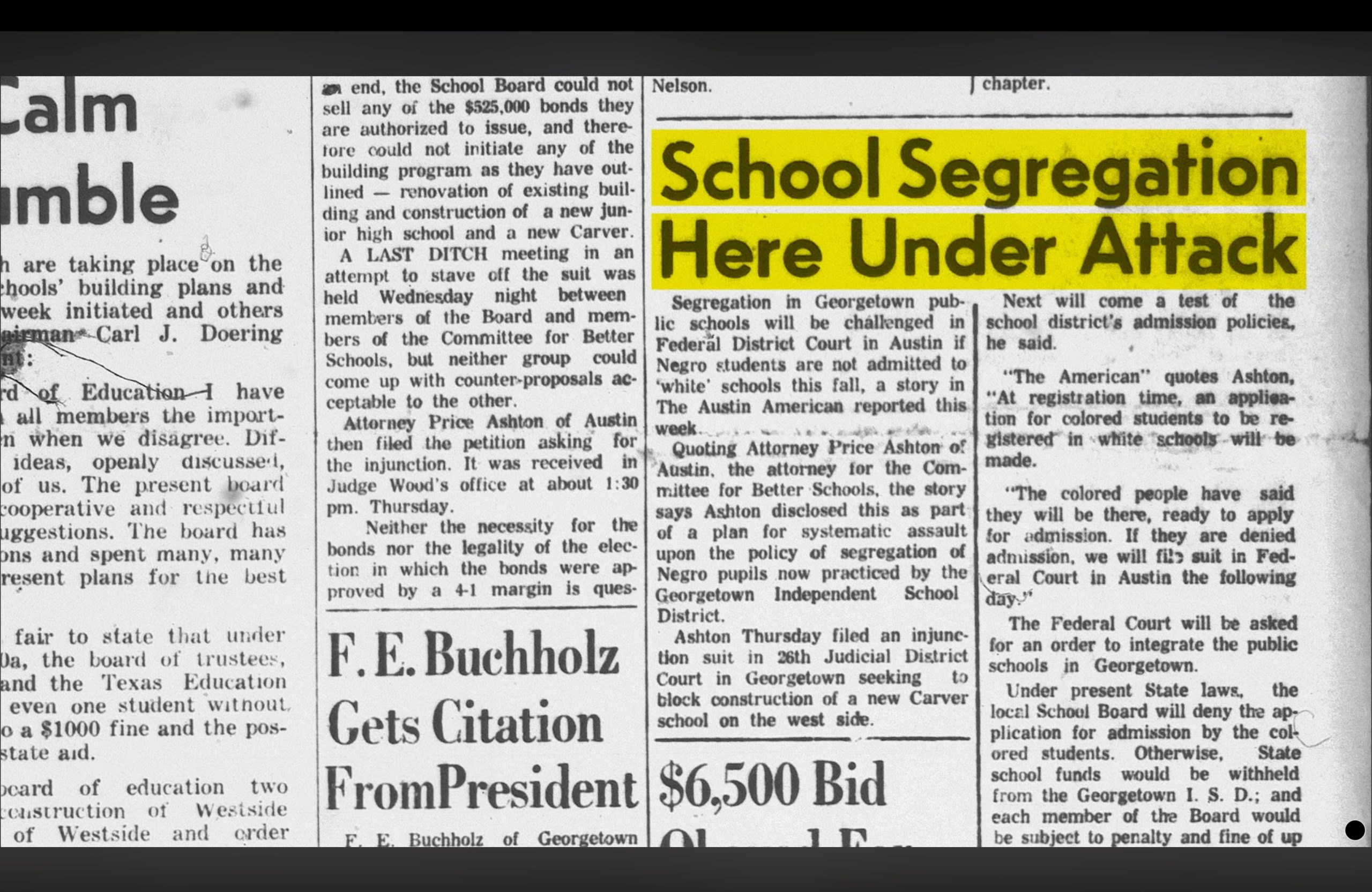
Segregation on Trial: Integrating Georgetown Schools chronicles the steps and processes taken in the 1960s to make the Georgetown education system just, and up to federal compliance. Debuting in February, 2026, the documentary begins by describing the segregated conditions in Georgetown up until then. Georgetown residents of color who were interviewed described the environment as hostile and not built for them. One resident shared that in order to obtain a burger from the nearby diner, she would have to wait in the back by the alley. The documentary also touches on the Georgetown Track, Ridge, and Grasshopper (TRG) neighborhood, which is predominantly Black.
After segregation was nationally declared unconstitutional in Brown v. Board of Education, there was a nationwide push toward integration. The segregated school for African-American children, the Carver school, was described as deplorable and an anti-constructive environment for learning. There was no library, no laboratory, no foreign language, and no music program; overall, it was a bad environment. There was a push from part of the community at the time to keep segregation in place. To combat this, professors from Southwestern University and community members united under United Methodist values to fight against it. They raised over $3,000 ( which was a lot for the 60s) to file a lawsuit against the school board. The intersection of education politics in this situation also arose while the City of Georgetown was trying to appraise its school district, which led to the formation of the committee for better schools. In the end, after much fighting for social justice, integration was achieved.
A lawsuit was filed at both the state and federal levels to challenge Georgetown’s school district. COG had decided to ignore the federal verdict and keep schools segregated. The aforementioned $3,000 was dedicated to this lawsuit, which was eventually won. The condition of the Carver school, in contrast with the alternatives, was so drastic that many parents shared that they would not mind holding their child back a grade if it meant they could go to the white school. The efforts of socially conscious community members and the FUMC church greatly contributed to the educational system in Georgetown that we know today.
If it were not for the efforts of conjoined Southwestern University and Georgetown community members, Georgetown as we know it would be drastically different. Their efforts in the ‘60s have translated to today’s social justice movement, which continues, but has made great progress.