
Taking Pride in Your Sexual Health

Share

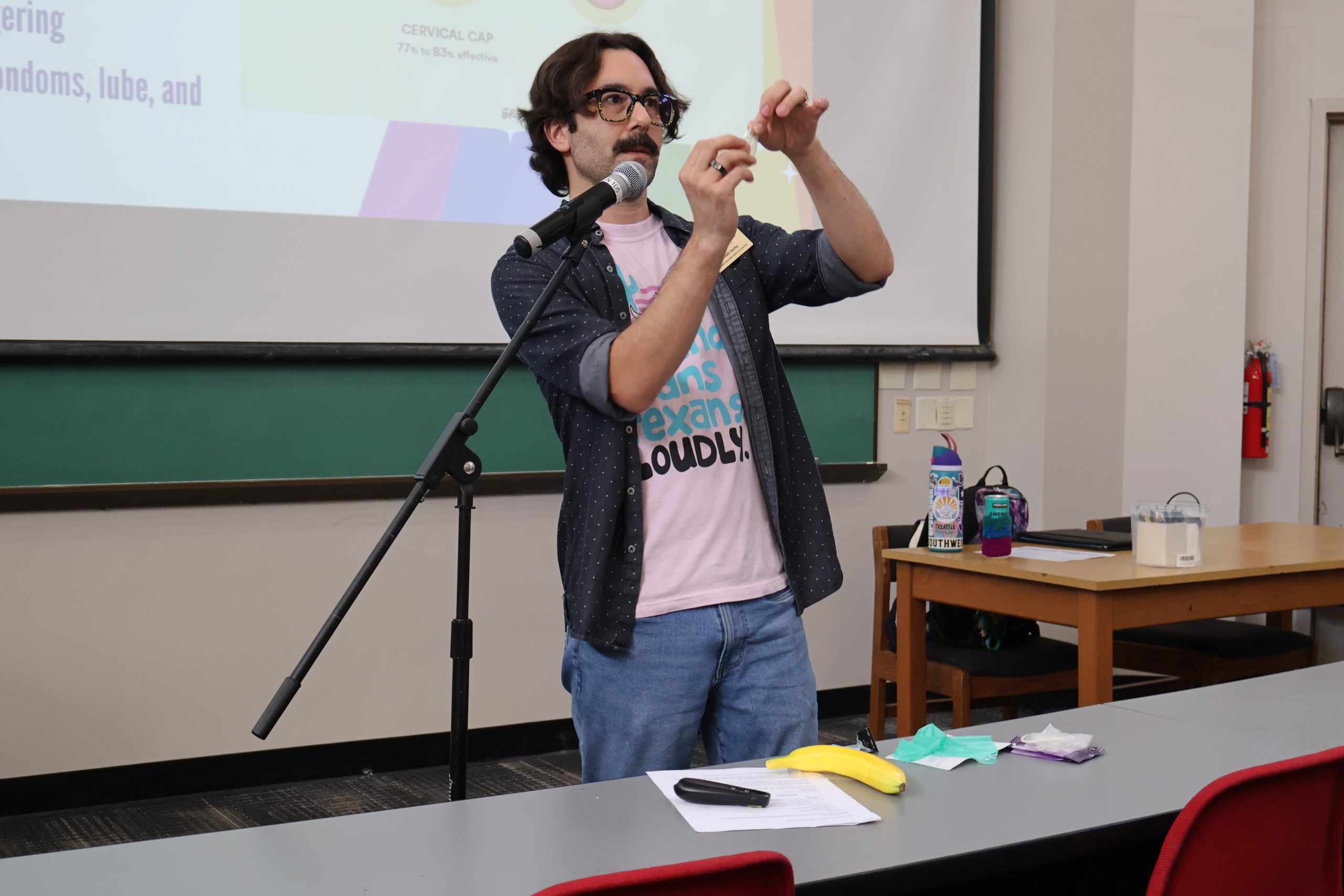
Sex. We all know what that word implies, and in many cases, it is usually kept as a private matter. But keeping it in a privatized sphere also discourages people from asking questions related to their own sexual health and well-being. Of course we have access to online resources, but the internet is vast and filled with misinformation, or information that might not pertain to you specifically, the latter especially relevant for the queer community. So, on Friday, September 25th at 5 pm, Randall Ischy, Southwestern’s Project Director for Violence Prevention & Response, partnered with Pirates 4 Pride to organize a workshop for students to learn about queer sexual health and relationships, and provide an overview on healthy sexual habits.
To begin the workshop, Ischy asked everyone in the room to anonymously submit their questions on “what’s something you wished you learned about sex before going to college?” After a quick overview of what kind of questions were asked, and also experiences of various students’ sex education in schools, Ischy began his presentation with a brief overview of the female and male reproductive systems. Then, he began explaining various barrier contraceptives, which are literal barriers between you and your partner that you can use during sex (ie., condoms, etc.), as well as some methods we can use these barriers in. To demonstrate how to put on/take off a condom, Ischy used a banana to visualize the proper way to put on and then discard it effectively and safely. Ischy also emphasized on-campus resources, one being that the Counseling & Health Center has free condoms, lube, and dental dams available for students.
Ischy then went on to explain hormonal contraception, which prevents pregnancy for people with uteruses using hormones. Methods like pills, which are daily, or implants, which are every 3-5 years, are examples of some birth control methods. One thing to note is that these contraceptives are only effective if you follow directions during use and do not protect against STIs. They may also help with other issues, like endometriosis. But you should always consider what works best with your lifestyle.
Next, Ischy wanted to emphasize how STIs are spread and some facts about HIV. There are 3 types of STIs: viral, spread through bodily fluid exchange and skin to skin contact; bacterial, spread through direct contact with infected area; and parasitic, spread through intercourse and close genital contact. HIV, a viral type of STI, is something anyone can get. It can spread through having intercourse with someone without a barrier contraception and the other person has HIV, sharing syringes and needles, and even through pregnancy if the person carrying has HIV. But a big thing to note is that knowledge is the first step in preventing sexually transmitted infections, so make sure you do your research and make plans so that you can be safe.
Vaginal sex should never hurt, so some tips on vaginal sex safety to keep in mind include knowing that pain before or after sex may be due to lack of lubrication, so consider using lube and use more if need be. If the pain persists, consider seeing your doctor. Most importantly, communication is essential so be sure to talk to your partner if something is painful or uncomfortable. Additionally, douching isn’t necessary as the vagina cleans itself. Just like how vaginal sex shouldn’t hurt, anal sex shouldn’t ever. However, more prep goes into anal sex, and unlike the vagina, the anus does not lubricate itself, so use plenty of lube. Go slow when beginning sex and as always, communicate with your partner if you are uncomfortable or in pain.
Ischy continued the presentation by moving on to oral sex safety, which includes all sexual acts where a mouth comes in contact with genitals or the anus. For oral sex on a penis, use an external or flavored condom. For oral sex on a vulva, use a dental dam, which can be created from a traditional or flavored condom. If you have bleeding gums, ulcers, sore throat, or recent dental work, avoid oral sex. Your own health and safety should always come first.
On the topic of orgasms, Ischy emphasizes that orgasms do not have to be the goal of sex; sex can be enjoyable without them. Many medications also can make orgasms difficult to achieve and focusing too much on them can make sex more stressful. Of course there’s no wrong way to orgasm, but it shouldn’t be the only goal or even necessary. Another important advice is to always pee after sex. Not only does it avoid bacteria, but it’s also a human need.

Ishcy’s presentation placed special emphasis on the fact that consent and boundaries are crucial. Before engaging in things like kink, always make sure to discuss hard & soft limits, a safe word/gesture, and aftercare needs with your partner. Also practice RACK (risk-aware consensual kink), as participants should be fully aware of potential dangers and make informed decisions accordingly; some kinks can be more dangerous than others, so make sure you communicate with your partner before you begin.
After the overview on healthy sexual tips and how to prevent infections, Ischy continued with a 101 on queer sex. There is no “one size fits all” in queer sex, as much as heteronormative and cis-normative expectations may imply otherwise. Many different activities, such as kink, roleplay, or anything that feels intimate and affirming to you and your partner(s) can be considered sex for queer folks. Ultimately it’s up to you to communicate to your partner what you like and what/when you’re comfortable.
Additionally, taking any hormones like estrogen, testosterone, ect, can develop different effects on your sex drive, but ultimately your identity is valid. However, if you use toys during queer sex, always make sure to clean them, check with your partner what toys you want to use, communicate boundaries, and use a toy with a flared base for any type of anal play so that it won’t be stuck. Additional dos (and don’ts) include learning the terminology (though you are not obligated to use them), have an aftercare plan, make sure your hands are washed beforehand if its going inside of anyone, clip/file your nails, take care of your long nails before going inside of anyone, and don’t equate HRT with contraception.
Finally, Ischy provided information for students to know about Southwestern’s campus resources, including, but not limited to, the Counseling & Health Center (PRC 200), the JEDI Center (MCC 334), Title IX (WCC 124), the Pirates 4 Pride student organization which meets every Thursday at the JEDI Center, and Ischy himself (ischyr@southwestern.edu). For more information on Southwestern’s resources, check out this document for SU’s guide to healthy relationships and more!
Before ending the evening, Ischy asked students to partner up for a short pizza activity and asked them to communicate with their partner what pizza they like and what they would want in order to illustrate how we would communicate consent. What we like, what we don’t like, and how we can come to a middle ground is not as complicated as some people may think. Consent shows up every day in our lives and Ischy used the acronym, FRIES: freely given, reversible, informed, enthusiastic, and specific, to describe the different types of consent. No matter what situation or decision, you should always make sure to communicate your consent, and that it is your choice and it’s only present when there is equal power. Consent is not the absence of a no, but a presence of a YES. If you or someone says NO, that is it. Additionally, if a person is incapacitated, passively complying, coerced, forced, or if a person has power over you and manipulates their privilege, that is NOT consent. Always practice giving consent, and continue asking for consent whenever you or your partner decide on something. In terms of online dating, always make sure to protect yourself and don’t share personal information, and when meeting a person, make sure someone knows where you are, and always trust your instincts.
To conclude the night, Ischy wrapped up his overview by summarizing that you shouldn’t let people pressure you into coming out, it is your decision to discuss your gender identity, sexuality, your genitals, or any other part of your body with a potential partner. Always be sure to prioritize your safety at all times, and most importantly, (and we know we’ve said this a lot but it’s very important we reiterate) communication is the most important safety tip for everything you do. Good communication starts way before the bedroom and the better you communicate, the more likely you will have a good relationship (with good sex as well).
Ischy’s presentation on sexual health, what to look out for, and advice on safety not only brought an eye-opening lesson for us, especially for those whose sex education was limited or barely existent, but also brought the discussion of why we need to be more open about the topic of sex. Keeping sex in a private sphere is good for personal preferences, but when it comes to unanswered questions about sexual health and safety, we shouldn’t be afraid to ask and expand our knowledge, especially when it comes to our own bodies. No matter if it’s your first time, or have done it before, I hope these tips and advice have answered your unanswered questions too.