
A Home for The Heart: Places of Worship in the Georgetown Area

Share

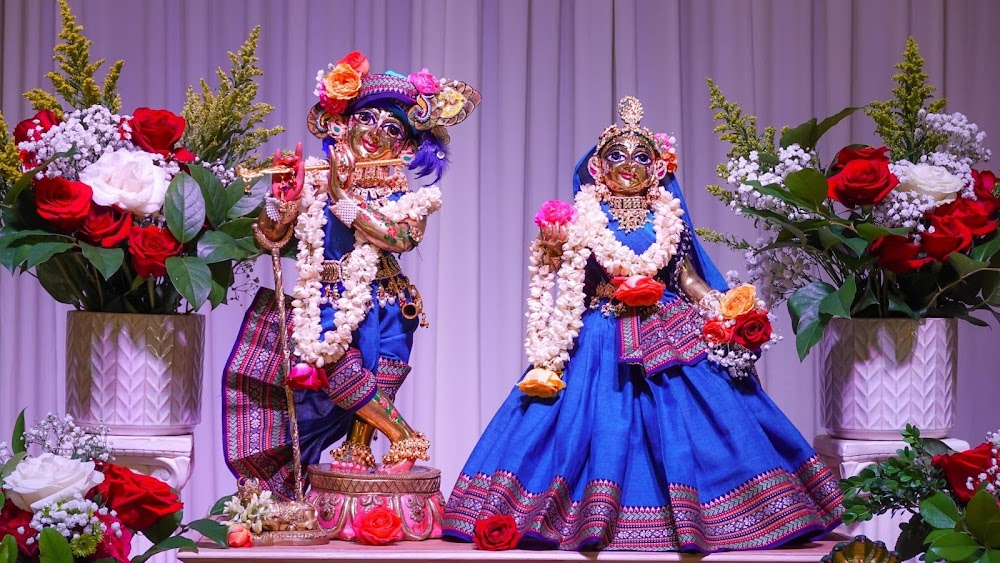
Austin and the Georgetown area are practically bursting at the seams with people from all walks of life. While Austin might have more variety, surrounding communities such as Georgetown play host to many different temples, mosques, churches, and congregations of religious faiths. Even though faiths like Christianity are more widespread in the region, it is still important to be open to experience and learn about religions outside our own or lack thereof. Becoming familiar with practices and faiths expands our empathy as people, promotes tolerance, and deepens our understanding of ourselves and others as human beings. For a more extensive list of places of worship near Georgetown, both Google Maps and this master doc have more information.
This research project occurred over one semester and intends to shine a light on lesser known beliefs with places of worship in the Georgetown area. This is by no means an exhaustive list and is only reflective of the research and experiences of the author.
The Sotaesan Center
Named after Sotaesan, born Park Chungbin (1891-1943), the center is a space for reflection, meditation, and cultivating one’s spirituality and humanity. They follow Won Buddhism, founded by Sotaesan around 1916. Despite its name, Won Buddhism is considered not a sect of Buddhism but its own religion, inspired by Buddhism and possibly Confucianism, Taoism and Cheondoism. In this way, Won Buddhism and Buddhism might be akin to how Mormonism relates to Christianity. According to The Essence of Won Buddhism by the Venerable Wolsan, Venerable Yetawon, and Reverend Dosung Yoo, the core mission behind this rather new religion is to help practitioners find the mental strength to break “the chains of ignorance that bind our hearts and lives”. These high-ranking monks and those who follow in their footsteps believe the path to a greater understanding eventually leads to a better world, or the Il-Won (“One Circle”) that represents both the ultimate reality, the origin of the universe, and our original nature as human beings. Teachings that inspired the religion were shifted so followers could practice the path to enlightenment without having to sacrifice their everyday, more secular lives.
Faith in Won Buddhism (also referred to as Il-Won-Sang – “One Circle Image”) relies on something known as the Fourfold Grace: the Grace of Heaven and Earth, the Grace of Parents, the Grace of Fellow Beings, and the Grace of Laws. This Fourfold Grace is the source of all blessings and good things. Realistic faith and practical buddha offerings are keystones to the faith, which views that treating everything as Buddha is an act of faith. This translates to helping other people and treating them with the utmost respect and also translates to showing gratitude to the Fourfold Grace because humans are inherently indebted to them. In practice, Won Buddhism is a faith that occurs in the quiet moments of the everyday – forming one’s spirit to be peaceful, practicing meditation, and replacing negative habits with positive. As Sotaesan is quoted as saying, “If you do so, there is no one who cannot become a buddha”. The goal of life in Won Buddhist practice is to fulfill the Four Great Vows, which are listed below as described in The Essence of Won Buddhism.
- Sentient beings are numberless. I vow to save them all.
- Delusions are endless. I vow to extinguish them all.
- The teachings are infinite. I vow to learn them all.
- The Buddha Way is supreme. We vow to attain it.
These vows may seem rather unattainable but their message is clear. They aim to encourage followers of the practice to free sentient beings (likely humans) from distress, rid themselves and others of false beliefs, learn what they can about their faith, and attain enlightenment. As for death, Won Buddhism believes in the cycle of rebirth, which can be broken through enlightenment – after which one obtains eternal life. In this belief, nothing truly dies but simply undergoes a change of form like a caterpillar’s metamorphosis.
Criticisms of Won Buddhism include suspicions that it may fall under the umbrella label of “cult”. The term “cult” is usually associated with “social groups defined by their extreme religious, philosophical or spiritual beliefs focused on a particular personality, object or goal. These groups often use devious psychological techniques to gain and control adherents (i.e. high pressure recruiting tactics) and are often characterized by socially deviant practices or novel beliefs” (Cookman University). There is no current publicly available information as to if Won Buddhism falls beneath such a term, but there were no such inklings during my visit to the site. Another concern regarding the faith is their beliefs surrounding gender, especially in relation to the treatment of female clerics. Among other things, female clerics are barred from participating in any sort of ministry after marriage and live at the temple even after marriage unlike male clerics, forcing most of the workload onto female clerics (Kim SungSoon). This may have been rectified in the years since the aforementioned article but still may be cause for concern regarding treatment of practitioners, especially female practitioners.
The Sotaesan Center itself, located in Round Rock, serves several functions. The center hosts a small library of both spiritual and secular books, including works by Ralph Waldo Emerson, Anne Frank’s Diary of a Young Girl, and of course religious texts like A Diagram for Practice of the Doctrine of Won Buddhism. Visitors are allowed to check out books and return them in three week’s time. The center is also home to Won Media, an in-house facility that handles printing, publishing, copying, and graphic design for both customers and the center’s magazine. Mind Study Magazine, which the center will publish another issue of later this year, covers topics related to the faith, meditation, and interactions between faith and daily life. Lastly, the building also houses a center for meditation and reflection. The center is open Mondays from 2:30-5:00 PM and Thursday-Friday from 10:00 AM-5:00 PM. Visitors are always welcome and encouraged to visit, and the staff is kind and welcoming. To find out more information or schedule a meditation time, their site is linked here.
ISKCON Round Rock
Also located in Round Rock is a satellite location of The International Society of Krishna Consciousness (ISKCON). Additionally known as the Hare Krishna movement, this belief touts over one hundred major centers, temples, rural communities, affiliated vegetarian restaurants, local meeting groups, and millions of members worldwide. This movement follows the philosophy of Bhakti Yoga, a devotional service in which Absolute Truth is known as a person – Krishna. Krisha is accessible through the path of bhakti, which is considered an easy, everyday practice given by God. The purpose of Bhakti Yoga is to align and reunite the practitioner with God through remembering the good things he has given, chanting his name and listing his glories, prayer, and worship. Founded in 1966 by His Divine Grace A. C. Bhakivedanta Swami Prabhupāda in New York, ISKCON has spread widely and quickly in less than 50 years on the global stage. Their beliefs are a part of Gaudiya Vaishnavism, a disciplinic line of Gaudiya Bhagavata Vaishnavas – or, in simpler terms, Krishnaism. Influenced by early Western conversions, ISKCON’s philosophy reflects monotheistic Krishna Vaisnavism in which Krishna is described as the source of all the avatars and is worshipped as the highest form of God (svayam bhagava).
The basic Hare Krishna beliefs, as stated on the official website are as follows:
“1. By sincerely cultivating true spiritual science, we can be free from anxiety and come to a state of pure, unending, blissful consciousness in this lifetime.
2. We are not our bodies but eternal, spirit souls, parts and parcels of God (Krishna). As such, we are all brothers, and Krishna is ultimately our common father. We accept the process of transmigration of the soul (reincarnation).
3. Krishna is eternal, all-knowing, omnipresent, all-powerful, and all-attractive. He is the seed-giving father of all living beings, and He is the sustaining energy of the entire cosmic creation. He is the same God as The Father Allah, Buddha and Jehovah.
4. The Absolute Truth is contained in the Vedas, the oldest scriptures in the world. The essence of the Vedas is found in the Bhagavad-gita, a literal record of Krishna’s words.
5. One can learn the Vedic knowledge from a genuine spiritual master – one who has no selfish motives and whose mind is firmly fixed on Krishna.
6. Before one eats, one offers to the Lord (Krishna) the food that sustains all humans; then Krishna becomes the offering and purifies the offered.
7. One performs all actions as offerings to Krishna and does nothing for one’s own sense gratification.
8. The recommended means for achieving the mature stage of love of God in this age of Kali, or quarrel, is to chant the holy names of the Lord. The easiest method for most people is to chant the Hare Krishna mantra: Hare Krishna Hare Krishna Krishna Krishna Hare Hare Hare Rama Hare Rama Rama Rama Hare Hare.”
Through these, one is able to glean more information about the faith within ISKCON’s walls, which is characterised through both the sameness between mankind and God and God to other interpretations of an almighty being, such as Allah, Buddha, and Jehovah. Faith in the Hare Krishna tradition is seen in personal practice like meditation and prayer but also through the collective action taken by the temples and their communities worldwide. They promote bhakti-yoga and Krishna Consciousness through festivals, the performing arts, yoga seminars, public chanting, and distributing literature. Members of the faith have additionally done good by opening hospitals, schools and colleges, and arranging free food distribution in communities with need.
Unfortunately, the Hare Krishna Movement shows some concerning signs of cult-like behavior. A former member of the organization, Steven J. Gelberg has alleged the movement uses authoritarian control, deception, abuse, psychedelics, internal corruption, and misogyny among other scandals (William Branham). ISKCON as an organization has admitted to child abuse within the faith between 1971 and 1986 (ISKCON Communications). The organization claims to have rectified this, but this cannot be proved as of now. Additionally, there has been marginalization and abuse committed against women within the organization. ISKCON follows a rather patriarchal structure, under which many female devotees are subject to manipulation and abuse (CESNUR). ISKCON’s own scripture also loosely encourages actions of disrespect against women, with text from Srimad Bhagavatam 4.25.24 reading “Since I have been engaged in the transcendental loving service of Krishna, realizing ever-new pleasure in Him, whenever I think of sex pleasure, I spit at the thought, and my lips curl with distaste”.
The temple in Round Rock holds events such as the upcoming Kirtan Cruise on Lady Bird Lake occurring May 31st. The temple also provides a cultural center and space for several communities, with an intent to build a congregation that is inclusive of all who might wish to learn more about their tradition of faith. ISKCON is open for worshippers and visitors from 9 AM – 5 PM on Saturdays only. To learn more about beliefs, events, or anything else of interest, visit their website.
Georgetown Islamic Center
Originating in around 610 C.E., Islam is considered to be one of the oldest religions in the world and has a large following today. Here in Texas, the estimated number of Muslims was 313,200 as of 2020 (World Population Review).The vision of the Center is to “create a comprehensive institution serving our local community through a vibrant Masjid and a dedicated Islamic Education Center. We strive to seek the pleasure of Allah by spreading the authentic teachings of Islam in light of the Qur’an and Sunnah.” In different terms, they wish to provide the Muslim community in Georgetown and the surrounding area with a Mosque for worship and a center focused on exploring the Islamic faith in full.
The faith of Islam is based in the Qur’an, which is said to be the direct word of Allah as revealed to the prophet Muhammad. The Qur’an is also called other names, those being Quran and Kitab (Recital & Writ), Kalam Allah (Divine Speech), and Dhikr and Huda (Remembrance & Guidance) (Qur’an.com). While beliefs in Islam may vary and can be hard to define, one can look to the 6 Pillars of Faith as a starting point. They are listed below as described by theMasjid Ar-Rahmah (Mosque of Mercy).
- Belief in Allah – Allah is the creator, sustainer, planner, and King of everything in existence. There is nothing that can be similar to Allah, as only He possesses specific names and attributes. Allah also created humankind to worship him, and those who worship another deity or deities are considered misguided.
- Belief in Angels – Angels are the servants of Allah and have different attributes and jobs in which to serve Allah. These include Jibreel, Malik, Ridwan, and Israfeel. It is believed that each Muslim has with them two angels who record their deeds in a book, whether good or bad.
- Belief in Revealed Scriptures – Allah has revealed His word through different avenues over time. They include the Torah, the Gospel as given to Jesus, the Psalms (Zaboor), the scriptures of Ibrahim (Abraham), and the Qur’an itself.
- Belief in Messengers – All the messengers who carried parts of Allah’s word were sent by Allah. The 25 messengers named in the Qur’an are:Adam, Idrees, Nooh (Noah), Hood, Salih, Ibrahim (Abraham), Lut (Lot), Ismail, Ishaq (Isaac), Ya’qoob (Jacob), Yusuf (Joseph), Shu’ayb, Ayoob (Job), Dhu’l-Kifl, Moosa (Moses), Haroon (Aaron), Dawood (David), Sulaymaan (Solomon), Ilyaas (Elias), al-Yasa’, Yunus (Jonah), Zakaria, Yahya, ‘Isa (Jesus) and Muhammad. They were all chosen and sent by Allah for the purpose of sharing his message to the people of the world.
- Belief in Last Day – There will be a Day of judgement, upon which Allah will judge mankind based on their deeds during life. The book written by their angels will be read so they may reflect on choices made during life.
- Belief in Divine Decree (Al-Quadar) – Everything that happens, whether good or bad, is decreed by Allah based upon His wisdom and knowledge. Allah does not punish His creations to be unjust but to better them in some way.
Islamic practice rests on a spectrum, interpreted differently through cultural lenses and physical locations. In the modern-day, most worries about practitioners of Islam revolves around the use of Sharia Law. Sharia, or “the correct path”, guides the personal practices of Muslims around the globe. However, majority Muslim countries take the guidance of Sharia beyond the personal, with around half mentioning it in laws and legislation (Council on Foreign Relations). Though the impact of Sharia may vary by country and interpretations of Islam, Sharia Law or Islamic Law can raise some concerns. Among these are harsher rules and punishments for women including the enforcement of wearing hijab or niqab. The Georgetown Islamic Center and other sites for the worship of Islam here in the United States may or may not agree with the enforcement of Sharia Law systems and to what extent, as the practice is currently in debate both secularly and otherwise.
The Georgetown Islamic Center aims to educate both Muslims and visitors at their location in the word of the Qur’an and how one can live to best embody the wishes of Allah. They hope to educate, convert, and create a welcoming environment for those who practice or are curious about the Islamic faith. The Center also offers resources for support and growth, including a New Muslim Resource Guide, and excuse letters practicing Muslims can use for Ramadan and Eid. The monthly schedule of events at the Georgetown Islamic Center can be viewed here or on theirwebsite.
Satanic Temple Austin
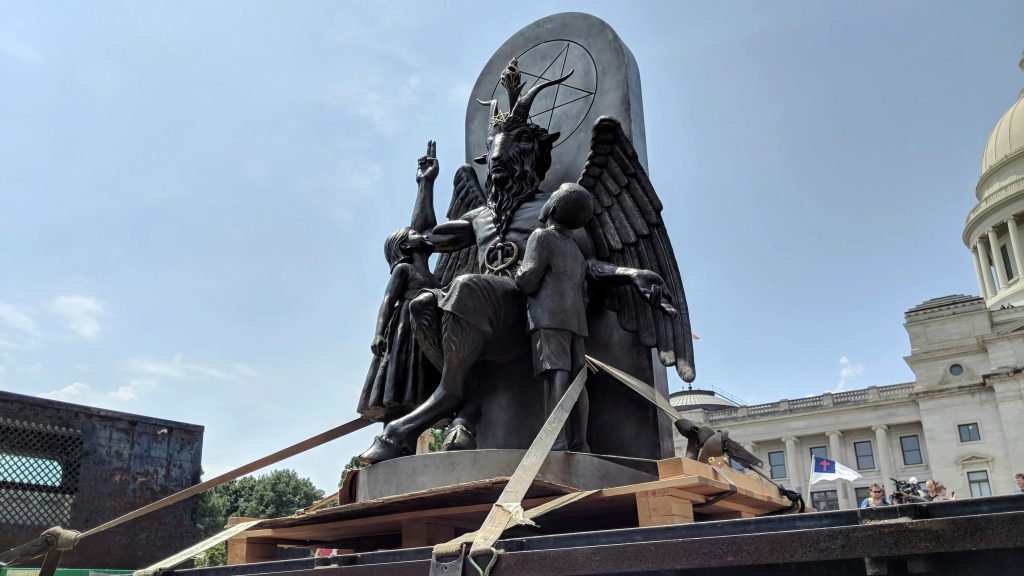
Unlike the other faiths listed here, The Satanic Temple of Austin currently has no brick-and-mortar location. However, they do hold events in Austin for members of the Temple and any curious minds who may be interested in participating in socials or philosophical discussions. Founded in 2013 with the Austin temple established a mere 3 years later, The Satanic Temple (TST) is a non-theistic branch of Satanism. Non-theistic Satanism, despite conversations surrounding the faith, does not believe in or worship an actual Satan, rather using the biblical demon as a figurehead and symbol with which to congregate like-minded individuals and create change. For specificity’s sake, I must point to the delineation between The Satanic Temple and the Church of Satan, as the two are often confused with one another. TST is not only officially recognized as a Tax Exempt Church by the IRS, considered a “Manifestation of Modern Satanism”, but also holds itself in conversation with modern occurrences (The Satanic Temple). TST takes it as their responsibility to aid the world at large, holding meetings and events regularly and advocating for policies the Temple is aligned with. Of the political views of TST, co-founder Lucien Greaves described the Temple as “A non-theistic movement aligned with Liberty, Equality, and Rationalism”. The Church of Satan, however, was founded in 1966 and relies on the writings of Anton LaVey as a structure upon which beliefs are built. It is the Church of Satan rather than The Satanic Temple that believes in some supernatural occurrences such as Magick and the importance of self-fulfillment.
As mentioned previously, The Satanic Temple is a philosophical belief rather than one that truly believes in and worships Satan. The Temple itself is committed to non-theistic belief and social change rather than conversion. Beliefs in the Temple are largely up to individual interpretation but are based upon the Seven Fundamental Tenets as listed below as stated by The Satanic Temple:
- One should strive to act with compassion and empathy toward all creatures in accordance with reason.
- The struggle for justice is an ongoing and necessary pursuit that should prevail over laws and institutions.
- One’s body is inviolable, subject to one’s own will alone.
- The freedoms of others should be respected, including the freedom to offend. To willfully and unjustly encroach upon the freedoms of another is to forgo one’s own.
- Beliefs should conform to one’s best scientific understanding of the world. One should take care never to distort scientific facts to fit one’s beliefs.
- People are fallible. If one makes a mistake, one should do one’s best to rectify it and resolve any harm that might have been caused.
- Every tenet is a guiding principle designed to inspire nobility in action and thought. The spirit of compassion, wisdom, and justice should always prevail over the written or spoken word.
Most fears of The Satanic Temple or Satanism as a belief grew from the Satanic Panic. Although worries about Satanic worship can be traced back to witch trials such as those in Salem, the most well-known Satanic Panic was that which was seen in the 1980s and 1990s. It was from this that metal music and even Dungeons & Dragons were accused of having Satanic properties (History). These fears seem to be rather cyclical in nature, but the legal system has likely learned after the fraudulent daycare interviews. These interviews, as published in Taylor & Francis, while widely shared as proof of how worshippers of Satan were not only in preschools but abusing children there. McMartin Preschool and Kelly Michaels were among those accused, but it was later revealed suggestive interviewing like leading questions may have been used to extract the “right” answers, therefore fueling Satanic Panic fears (Taylor & Francis).
Although The Satanic Temple and other branches of modern Satanism are still relatively new, the activist nature of TST as an organization occasionally draws fire from reporters and observers. Among other things, the Temple drew attention in 2024 over claims that abortion is a religious right. This “Satanic Abortion Ritual”, even if it were accepted by courts (which it was not), would not mean that it has to be legally recognized as “a permissible exercise of religion or defense to violating state abortion laws” (The Petrie-Flom Center). Additionally, the Temple consistently draws criticism from some Christians who believe that despite TST’s claims to not serve an actual Satan figure, they are unknowingly fueling the malicious biblical entity (Theopolis Institute).
In preparation for a project occurring adjacent to this article, I got the opportunity to interview a current member and leader of The Satanic Temple of Austin. He described his experience in the temple as a positive intellectual pursuit, in which members are encouraged to discuss and question beliefs. Using Satan as a metaphor or “mascot” for the philosophical movement tends to push some away, but draws in curious minds who are open to learning. They also described the Temple of today as an approachable, open organization. They hold social events at bars, hold open office hours at coffee shops, and occasionally hold public rituals such as the Black Mass. Black Mass is currently defined by Encyclopedia Britannica as “a blasphemous and usually obscene burlesque of the true mass performed by satanic cults. The naked back of a woman often serves as an altar, and a validly consecrated host is generally used to intensify the mockery. The rite commonly incorporates other elements of satanic magic…” This, however, is not reflective of the truth of the Black Mass as practiced by The Satanic Temple of Austin, which uses it as a reclamation of personal sovereignty.
While not having a physical location, The Satanic Temple of Austin does hold monthly social gatherings at the Crow Bar at 4 pm on the first Saturday of the month. They also vend at events, hold days of action, and other such community-centered opportunities. To view more about events, beliefs, or the Temple in general, visit their website.
The Church of Jesus Christ of Latter-Day Saints
Also known as Mormonism, the Church of Jesus Christ of Latter-Day Saints is a movement defined by its connection to the United States of America as a country. Founded by Joseph Smith in 1830 after the alleged discovery of the golden plates that would then become the Book of Mormon, the faith has remained in the modern memory thanks to missionaries, a musical, and most recently The Secret Lives of Mormon Wives. While often disputed by other denominations, Mormons unequivocally consider themselves a branch of Christianity. The main distinction most drawn upon is the lack of a trinity. This differs among other denominations as well, but the Church of Latter-Day Saints sees God, Jesus, and the Holy Spirit as distinct, separate beings who are united in purpose. The Godhead (God), is also seen as having a tangible flesh-and-bone form, just like you or I (Gospel Coalition). Other differences between Mormonism and mainstream Christian belief includes the definition of what Jesus is, the meaning of atonement on the cross and how it affects believers, belief in believer resurrections, and belief in male human deification (Truth In Love Ministry; Faithful Answers Informed Response Latter-Day Saints). According to the church itself, they focus on three main beliefs as listed on their website and below:
- Jesus Christ is the Savior of the world and the Son of our loving Heavenly Father.
- Christ’s Atonement allows humankind to be saved from their sins and return to live with God and their families forever.
- Christ’s original Church as described in the New Testament has been restored in modern times.
Prophets and presidents of the LDS church after Joseph Smith are given control over the church, its beliefs, and the interpretation of the scripture. Since the founding of the religion, 18 men have led the Latter-Day Saints church. In the modern day, the Church of Latter-Day Saints is widely known for its missionaries who knock on doors far and wide along with the practice of polygamy. They also follow a strict health code as written in the “Word of Wisdom”, which encourages a diet of moderation and abstinence from tobacco, alcohol, tea, and coffee (Religion Media Center). Faith in the Mormon church is practiced in various ways, like visiting the temple, baptism, confirmation, receiving the priesthood for men, temple endowment, and temple marriage.
The Church of Jesus Christ of Latter-Day Saints here in Georgetown positions itself as being a welcoming organization built upon the church’s morals and a passion for community outreach. In fact, newcomers to the church can even sign up to have someone sit with them during a service if they’re not comfortable attending alone. However, in the light of journalistic integrity, one must also point out the harms of Mormonism. It has been alleged that members of the LDS church who experience sexual harassment or assault are encouraged to never seek proper authorities or care, creating a space for such actions to thrive. There have been several lawsuits filed against the Church of Jesus Christ of Latter-Day Saints for perpetuating such abuse, even against minors (Axios). Beyond that, the Book of Mormon itself continues to teach things that raise eyebrows from those not within the faith. The most prominent of these is in 3 Nephi 2:15, when the Lamanites are converted to Christianity – “their curse was taken from them, and their skin became white like unto the Nephites”. While renounced by the Church in 2013, this passage is still quoted and used as justification for the belief that those with darker skin bear it as a “curse” passed down from their ancestors.
This is not to say that all Mormons prescribe to these harmful beliefs, but rather to point them out for those curious about the religion. Due to the presence of their missionary work and passion for conversion, the Mormon church is open to all visitors and will even allow curious souls to schedule meetings with missionaries. To learn more about the Church of Jesus Christ of Latter-Day Saints in Georgetown, visit their website or even dig into a digital copy of the Book of Mormon.
Faith Impact Church
On the surface, Faith Impact Church is just like any other church one might find in Georgetown. However, it is something within the walls that makes the practice of Christianity there a bit different than one might expect. Faith Impact Church practices what is known as Charismatic Christianity. Charismatics can spring forth from any existing denomination of Christianity, defined only by the belief in consistent supernatural works. The word “charismatic” as used here comes from the Greek word “charisma’, which means “spiritual gift”. It is the belief in such spiritual gifts that mark Charismatic Christianity, including speaking in tongues, healing the ill, and giving prophecy (Christianity.org). According to Faith Impact Church’s frequently asked questions, “We are charismatic in the sense that we encourage every believer to be filled with the Holy Spirit and to be empowered for God’s service in this world. We believe in the continuing supernatural work of the Holy Spirit.”
A pamphlet entitled “Why Tongues” by Kenneth E. Hagin explains more on the expression of faith. Hagin cites Mark 16:17 “And these signs shall follow them that believe…they shall speak with new tongues”, among other verses that detail miracles like speaking in tongues one was not taught. According to Hagin, tongues are simply an expression of the Holy Ghost as it enters a human body, seen as a sign that the Holy Spirit lives within that person. Tongues are also used for spiritual edification, or the strengthening of the Christian spirit in order to better stand against the forces of evil (Quartermaster Ministries). Praying in tongues is also thought to better align with God’s will, which is perfect and unchanging rather than wavering and reliant on faulty human knowledge. Similar views are held by the Charismatic movement in other denominations such as Catholicism, in which tongues and the laying of hands can be viewed as a path towards spiritual and physical healing (Charis International).
Despite their interpretation of tongues and other spiritual experiences, Charismatic churches also tend to draw criticism from some Christians over doctrinal and emotional misuses. According to an interview with John Piper, the current chancellor of Bethlehem College and Seminary, Charismatic churches can shift from a study of the Bible towards more performative, emotional experiences. In the interview, Piper claims that Charismaticism makes an “idol of emotion”, raising the experience of feeling, tongues, spirit healing, and prophecy above God in a way he considers disrespectful (Desiring God). Additionally, other denominations believe that Charismatic churches might spend more time on the cultivation and celebration of spiritual gifts than actively engaging with the scriptures of the Bible (Faith Baptist Theological Seminary).
I got the opportunity to visit Faith Impact Church for its Easter service and was pleasantly surprised. As a first-time visitor, I was treated with respect and kindness. There was speaking in tongues and a metaphorical laying of hands during prayer, during which congregants reached out towards a person standing in for the deployed members of the United States Army in Iran.
Despite weekly services, Faith Impact Church also hosts bible studies, ministries, and missions to all across the globe or volunteer opportunities for those who would rather glorify God from closer to home than jetset. All information about the church, including specifics about their beliefs and vision for the future, can be found on their website.
Conclusion
The experiences written here are only reflective of my research and personal experiences at the locations listed. No matter what you believe, it is important to bear in mind the traditions of others even if they may seem odd or different. Interreligious exposure can be an entry point into understanding different cultures, actions, beliefs, and help each of us gather knowledge with which to better understand the world (Parkview Health). With or without your own spiritual journey, I hope these snapshots of other walks of life were interesting, informative, and eye-opening. All the sites I listed are open to visitors and inquisitive minds, so please feel free to do your own research and explore the complex depths of faith, practice, and spirituality in the modern age.