
12 Gauges of Fun: Skeet Shooting with Outdoor Adventures

Share

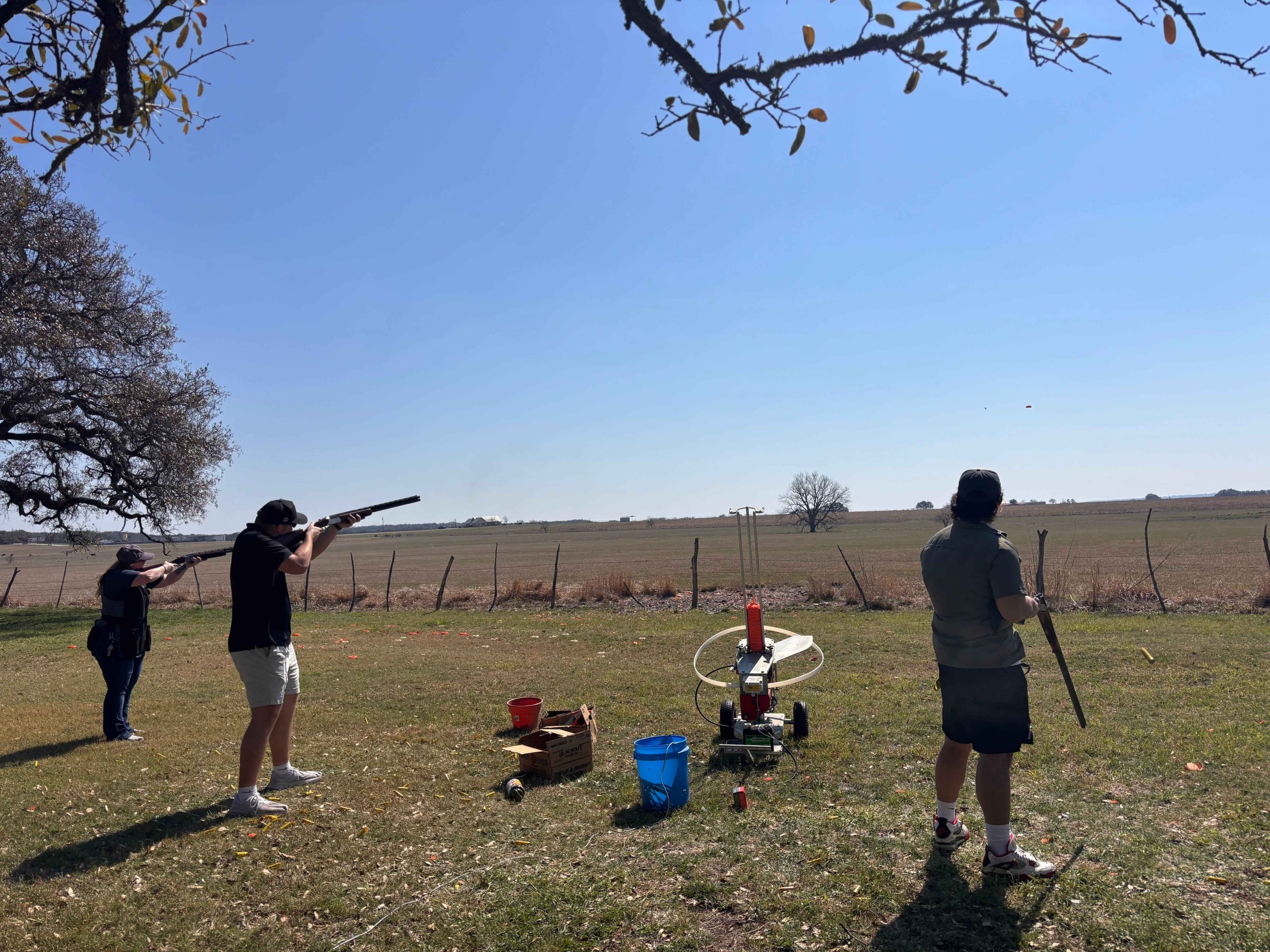
On Saturday, February 28, Outdoors Adventures traveled to Florence, Texas, to introduce a new activity never before offered in the program: skeet shooting. From learning the basics, testing your aim, and experiencing, in my opinion, the most exciting Olympic sport, I think this skill should stay for years to come. 7S Ranch offered to host these first games and teach safety protocols to beginners and experienced shooters alike.
The first lesson taught, and the most relevant for beginners like me before attempting to use a firearm, is how to handle the noise. At first it may seem intimidating, but it is much more bearable than it seems. A skeet shotgun typically produces an explosion of between ~140 and ~170 decibels. Therefore, it produces a very loud *bang*, considering that only ~85 decibels are needed to permanently damage your hearing. However, that is what hearing protection is for—which, by the way, is absolutely mandatory in this type of activity—such as earplugs and earmuffs that can reduce the noise level by up to ~20 decibels. It may not seem like much in writing, but once you are inside the shooting range, the impact on your hearing is much less noticeable. In this case, we were provided with standard earplugs that can dissipate up to ~10 decibels.
The second point, and one of vital importance, is obviously the handling of the firearm. In this case, Olympic shotguns such as the Browning Superposed were offered at 7S Ranch. This type of shotgun is collapsible, so to keep it in a safe position, it must be carried on the shoulder, completely folded, pointing at the ground, and with no cartridges inside. Common sense dictates that once loaded and ready, it should not be handled carelessly, pointing it anywhere without paying attention. Once both points have been clarified, the real fun begins in how to position yourself correctly to absorb the recoil without too much trouble.
With your back completely straight and your feet apart to maintain balance, ready to push backward, begin the aiming position. Your right cheek should be resting on the butt of the gun to coordinate your eye with the sight, and your left hand should be holding the front safety catch of the gun. With all this done properly, you can begin to practice your shooting as we were taught in the first hour of practice.
Here is a little shooting tip that was not mentioned in practice, but which is important for hitting all your targets. When aiming, do not line your sights up completely with the disc; try to predict where it will go. At least separate your sights from the disc by a finger’s width and shoot if you feel you have predicted its flight.
During the second hour of shooting, we were allowed to practice on the actual Olympic skeet shooting range. A skeet shooting range usually consists of a field with a high and a low hut, each with a window through which the clay pigeons are launched. The range is designed to simulate real bird hunting situations, with clay pigeons launched at different angles to test the shooter’s skills. The range usually includes eight shooting stations, each requiring a specific and random combination of shots to break the targets. However, due to time constraints, we were only allowed to shoot at three of the eight stations.
Considering this was the first time a skeet shooting lesson was offered as part of the program, it went quite well, as the registration filled up, leaving some students on the waiting list. This is unusual for events lasting less than a day, such as this one. Therefore, it is highly likely that another skeet shooting session will be offered next year, so keep an eye out! Let us hope that next time, participants will be able to play at all eight stations and test their skills in Olympic skeet shooting, because it is true, it becomes very addictive once you master your shot.