
A Blueprint for Success: Next Dimension Leadership Series With Jeff Williams

Share

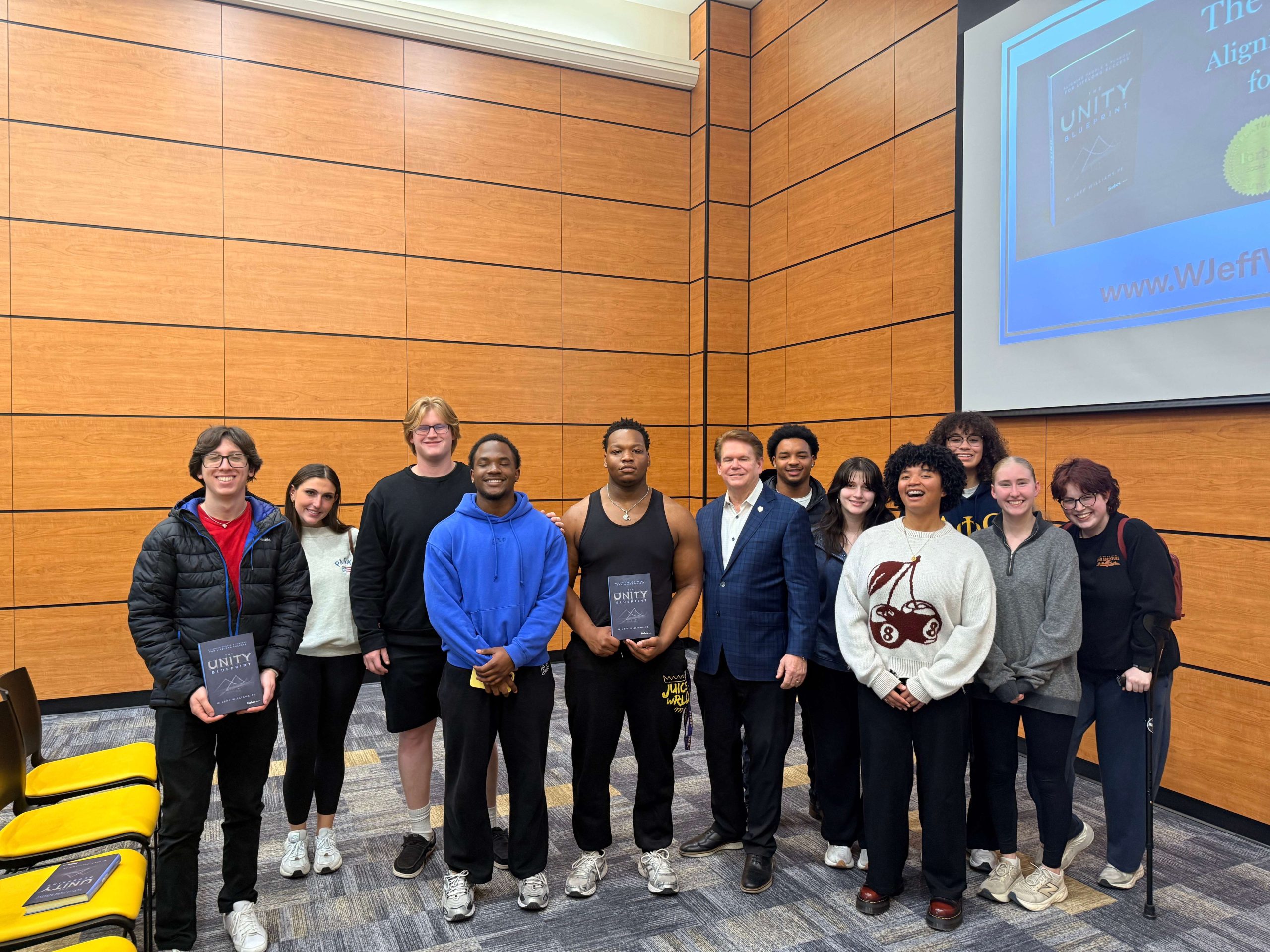
On Tuesday, February 24, 2026, Student Activities brought Jeff Williams to Southwestern as part of the Next Dimension Leadership Series. Mr. Williams is a civil engineer, the previous CEO of Graham Associates, and a former mayor of Arlington, Texas. Arlington, Texas, is not only Mr. Williams’ workplace but also his hometown, and it was awarded the National Medal of Honor Museum and recognized for his work leading the city out of the COVID-19 pandemic faster than any other major US city.
Mr. Williams began his discussion by choosing a student from the crowd, namely J’Lisa Chambers ‘28, to determine a connection between them. After briefly conversing with J’Lisa, Mr. Williams found out that she is from Arlington as well and is a communications major here at Southwestern. Additionally, although J’Lisa loves Arlington’s Tex-Mex, Mr. Williams is not as big a fan. However, he made the point that “some of the best friends [he has] ever made started over disagreements, not arguments.” This provided not only valuable information but also a healthy segue into his blueprint, which serves as a framework for success.
Mr. Williams’ first point in his blueprint is to “Develop Relationships and Value People”, because, in his own words, “even the biggest introverts need people.” To do so, he encourages individuals to find out where their new acquaintances are from and what they are hoping to do with their lives, even if it is not what they are doing at the current moment. This is due to the fact that interpersonal communication is how relationships start, as he demonstrated in his interaction with J’Lisa before he started his presentation. Mr. Williams then added on to his first point by explaining the importance of working together in community to reach more creative solutions, as the entire first point in his blueprint is “develop relationships and value people …and remember to adopt forgiveness as a core value.” He emphasized the importance of working together, especially after COVID, during which working virtually got in the way of successful teamwork. In his own words, “it is important to work towards unity and try to see where everyone else is coming from”, because “getting mad over something silly fills our mind and gets in the way of our being productive.” As a way to combat this, he shared advice he got from a Navy SEAL that in order to ground yourself when you get stressed or overwhelmed, you should wiggle your toes in order to think about something other than your issues.
The second point in Mr. Williams’ blueprint is to “Choose Your Environment Carefully”, which he himself did when he was a student at Texas Tech University, earning his degree in Civil Engineering. He was a student on scholarship, which meant he did not have the privilege to go bowling on Friday or dancing on Saturday. He eventually transferred dorms so that he could find peers who were more studious and used their time more intentionally. Instead of going with the tide, he encourages individuals to take control of their path, as drifting is unintentional, and you quite literally lose control of where you go.
The third point in Mr. Williams’ blueprint is to “Decide Your Character Early”, which, in his case, meant working in Washington, D.C., for a time and realizing that he did not want to spend his life working in politics. He specifically posed the question, “What do you want your obituary to say?”, because not only do you have to figure out what matters to you, you have to figure out what you would like to do about it and what is within the realm of your control. In Mr. Williams’ case, he met his wife in college, and they were able to figure out who they wanted to be, both individually and in their partnership. During his time as the mayor of Arlington, Mr. Williams was able to put things that he valued, such as citizenship and patriotism, into action by establishing the National Medal of Honor Museum in Arlington. He shared that the recipients of the medal wanted the museum to be established in their lifetime, rather than waiting for 20 years for it to be built in D.C. This is important for students and people in general, because “leadership is not sustainable without character values.”
The fourth point in Mr. Williams’ blueprint is to “Get Out of Your Comfort Zone”, which he
did not go as far in depth as his other points, but that does not mean it is any less important. In his own life, he demonstrated the importance of challenging one’s comfort zone by organizing a debate between Kent Hance and George W. Bush when he was a college student. At the time, Hance and Bush were running against each other for Congress in the 19th Congressional District. Mr. Williams shared that he and Hance stayed friends and that Hance was even involved in his children’s lives, which demonstrates the idea that “…lifelong connections can come from uncomfortable situations.” Furthermore, “unity does not mean that everyone believes in the same thing,” which supports Mr. Williams’ main idea that although success is straightforward, that does not necessarily mean that it is easy.
The fifth point in Mr. Williams’ blueprint is “Be a Lifelong Learner”, which is important in college, but also in life in general, as “your learning doesn’t stop when you graduate.” Mr. Williams emphasized that in the last ten or so years, technology has been changing especially quickly and immensely. This comes as a result of society and the world around us being ever-changing, even in just the last few years, and of necessity. The shift from desktops to laptops has made it so that people can work from home, while traveling, or even while on vacation; work can be completed wherever and whenever it needs to be done. In Mr. Williams’ own words, “we do not need to change it, we need to embrace it”, especially in terms of Artificial Intelligence. Accordingly, in his time as mayor of Arlington, he organized the testing of autonomous vehicles in the city to expand and maintain accessibility to public transportation in safe ways.
The sixth and next-to-last point in Mr. Williams’ blueprint is “Make a Plan – But Stay Flexible”, as, in his own words, “people will not follow you unless you have a plan.” In other words, study and research in order to make a plan, but also consult the people in your life. Mr. Williams tied this to his earlier point about us as humans needing support from our fellow human beings. Whether or not you go on to work in a large corporation, as part of a small team, or be self-employed, in the larger scheme of things, teamwork is beneficial for all parties involved, but being flexible makes all the difference. On leadership, Mr. Williams made the point that while a few people can make a difference, a thousand can make a difference even more effectively and efficiently, but, most importantly, “people will not follow you unless you have a plan.”
The seventh and final point in Mr. Williams’ blueprint is “Serve Something Larger Than Yourself”. In his own life, this means being involved with Mission Arlington as a volunteer. Mission Arlington is entirely run on volunteer support and based on donations in order to provide disadvantaged members of the community with support at no cost. This support comes in the form of holiday gifts, birthday presents, medical support, school supplies, and whatever else they may need. By putting some of his time towards serving those in his community, Mr. Williams is able to put his values into action in a tangible manner and can see the impact of his work on a daily basis.
Mr. Williams wrapped up his presentation with a handful of takeaways, which ranged from “Plans give you direction. Resilience allows you to pivot,” to “Your character is your most valuable long-term asset,” to “You do not drift into excellence. You design your environment.” He also shared three truths, which were “1. Employers want people who can work with others.
2. By staying out of conflict, your mind does not get consumed with discussion, decision, and stress. 3. It is amazing what you can get done when you avoid conflict and bring people together to work as a team.” The takeaway that stuck with me the most was “The world will change faster than your degree program”, because, even as a freshman, the importance of my college plans has been stressed to me for years, more so than my personal growth and experience during that time. I appreciate the reminder to use college as not only a time to learn in terms of my academics, but also who I am as a person, and what I can do with it, both in my career and in life in general.