
Protect Yourself: Title IX & Being an Empowered Bystander

Share

Content warning: The following contains mentions of sexual assault and harassment that may be upsetting to some readers. Please do not read further if this will disturb you. If you or someone you know may be experiencing or have experienced sexual misconduct, please contact a trusted authority such as the Title IX Office. Resources on and off campus are available here.
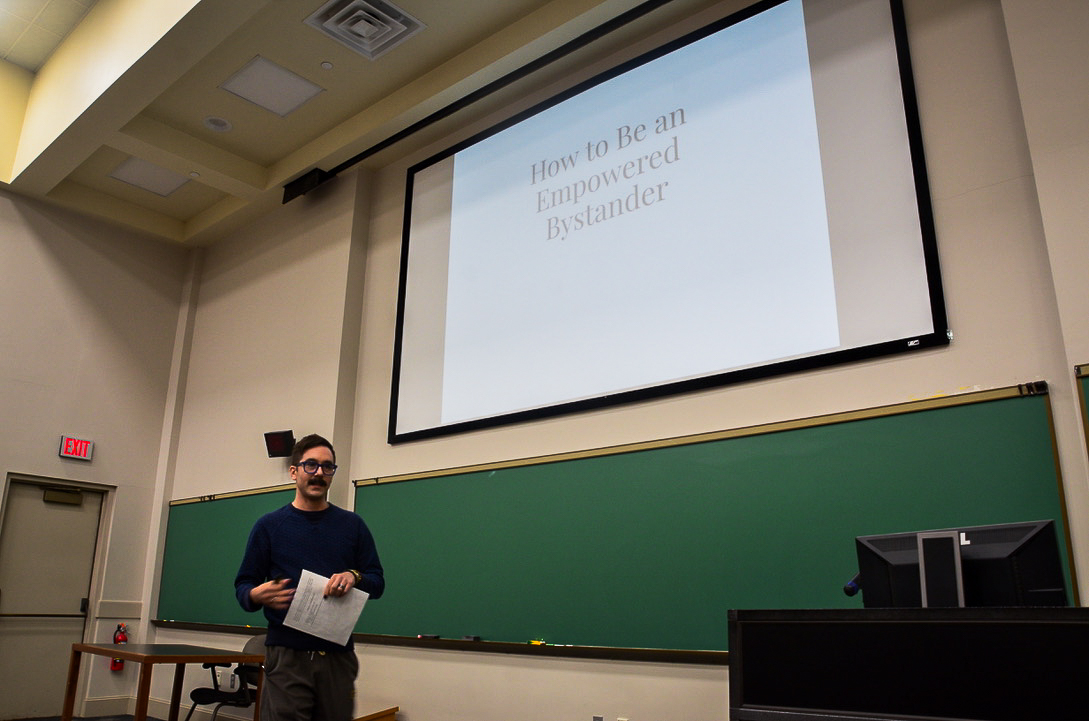
Here on our campus and across the world, people experience untold harm from those close to them. According to the National Sexual Violence Resource Center (NSVRC), over 40% of students may experience at least one sexually harassing behavior on campus (NSVRC). These occurrences both on and off campus have led to the formation of several resources on campus for the prevention and response to actions. These include the Title IX Office headed by Loren Galloway Bowans and Project Director for Violence Prevention & Response Randall Ischy. Their jobs include educating students and even staff at the university about how to recognize, prevent, and respond to situations in which abuse or sexual misconduct may be occurring. Both Bowans and Ischy find purpose and passion in this, hoping to enable those experiencing harm to take control of their situation and act – whether this be through formal reporting or seeking outside resources. In this workshop, the two covered the ways in which Title IX can aid students and how students can help others by being an active, empowered bystander.
Title IX
Passed in 1972, Title IX is a law that prevents discrimination and mistreatment on the basis of sex and extends to such things as sports, housing, and admissions. Although some might think Title IX is mostly aimed at protecting women, the law protects all people on United States soil, including international students on U.S. campuses and men. Here at Southwestern, Title IX and its Office on campus extend the law to other groups, prohibiting the following conduct: sex discrimination, sexual harassment, sexual assault, stalking, interpersonal violence, sexual exploitation, inappropriate sexual conduct, and retaliation. Southwestern’s policy is more expansive on the front of gender inclusivity and identity, defining sex discrimination as discrimination based upon a person’s sex, gender, sexual orientation, gender identity or expression, and pregnancy status.
The workshop also elucidated that stalking can often be something beyond the usual stereotype of a person being followed and watched from the shadows – it may also include constant texting, showing up where they are, bothering their friends, or threatening language to others or oneself. Additionally, it is important to remember that consent is informed, voluntary, and active. Without these elements, an act is not consensual.
Once a report on a person’s behavior is received, the process for action ensues. This process is entirely driven by the affected person, who decides whether action will be taken and how so. After the Title IX Office receives a report, the Coordinator will reach out via email to assess the affected person’s safety, inform them of their rights and options, explain how SU can help, and explain the process further. As mentioned previously, this is a confidential process with no obligation by the affected party to participate. The email will also provide resources and information for confidential resources and support measures, including resources at the Health Center, mutual no-contact directives, changes to class schedule, housing modifications, and many other options to increase the safety and wellbeing of students affected by prohibited behavior.
These resources and venues of report do not usually require police involvement or the submission of a formal complaint. If a formal report is filed through the Title IX Office, there are two main paths to resolution: alternative and formal resolution. Alternative resolutions require both parties’ agreement and participation, whereafter they work with a facilitator to find mutually agreeable remedies such as re-education, counseling, or something else of the sort. A formal resolution also requires both parties but not an agreement. Both parties are provided an advisor, whether within the Southwestern staff or an outside organization, such as an attorney. An investigation is made into the actions that resulted in harm to one party and the finalized report goes to a hearing by Southwestern staff. It is during this hearing that it is decided if the accused party is deemed guilty or not guilty. Both parties are able to appeal this decision if they so wish.
Despite the practices and procedures put into place by the university, not every incident of misconduct is reported. According to RAINN, only 1 in 3 victims of sexual assault report the incident to law enforcement (RAINN). Unfortunately, the same goes for victims on college campuses around the world. Despite the negative stigma that surrounds reporting experiences of misconduct, the submission of reports is vital to more than the Title IX Office. Reporting makes sure that the university is able to respond appropriately to these cases, informing safety on campus and providing data to help increase infrastructure (i.e. extra lighting in areas where misconduct tends to occur, education about recognizing and responding to misconduct). Reporting respects the autonomy of the person affected, letting them decide how actions take place rather than letting “Mouthwestern” steamroll their reputation on campus. Even in cases where drugs or alcohol are involved, Southwestern’s amnesty policy steps in when misconduct is present. After a report (and only so), no further action will be taken regarding the substances – rather, it’s more important to the university that students who experience misconduct are safe.
Being an Empowered Bystander
Witnessing an act of misconduct is not a usual occurrence. However, it is important that we be able to react accordingly should the worst happen in front of us. In an emergency situation such as witnessing an act of misconduct or a medical emergency, it is more likely that people will do nothing, something that has become known as the Bystander Effect (also known as bystander apathy or the Genovese effect). This social psychological theory posits that people are more likely to choose inaction in an emergency situation, especially when other people are present. Even if unlikely, it is good to understand and be able to use the 5 D’s of Intervention if we are in a situation where misconduct is occuring:
- Distract – Derail the incident of harassment by interrupting it.
- Examples:
- “Hey, aren’t you in _____ class with me?”
- “Can you direct me to ______?”
- Delegate – Bring in someone who is willing and ready to help
- Examples:
- A professor or staff member
- Loren Galloway Bowans or Randall Ischy
- Another student
- Document – Record or take notes of the incident
- Examples:
- Take a video or voice recording
- Take photos of the incident
- Delay – Check in with the affected person later
- Examples:
- “I’ve seen you around campus and think you look cool. Do you want to talk?”
- “I saw what happened earlier. Are you hurt/okay?”
- Direct – Speak up about the behavior when it’s happening
- Examples:
- “That isn’t okay to say. Break it up.”
Why it Matters Women, men, and gender non-conforming people around the world have experienced or will experience sexual misconduct in their lifetime. Reporting on your own behalf or on behalf of someone you are concerned about could prevent further abuse, sexual misconduct, or even worse. As a survivor of sexual misconduct myself, I find it especially crucial to learn how to protect ourselves and others from the harm misconduct can cause. If you’re interested in being a part of Southwestern’s ongoing fight against sexual assault and other misconduct on campus, you can take the Sexual Assault Campus Climate Survey or attend events such as this workshop. With your help, the Southwestern community can continue to educate, prevent, and better respond to sexual misconduct on campus and beyond.