
Wicked Part 2: Changed for the Better?

Share

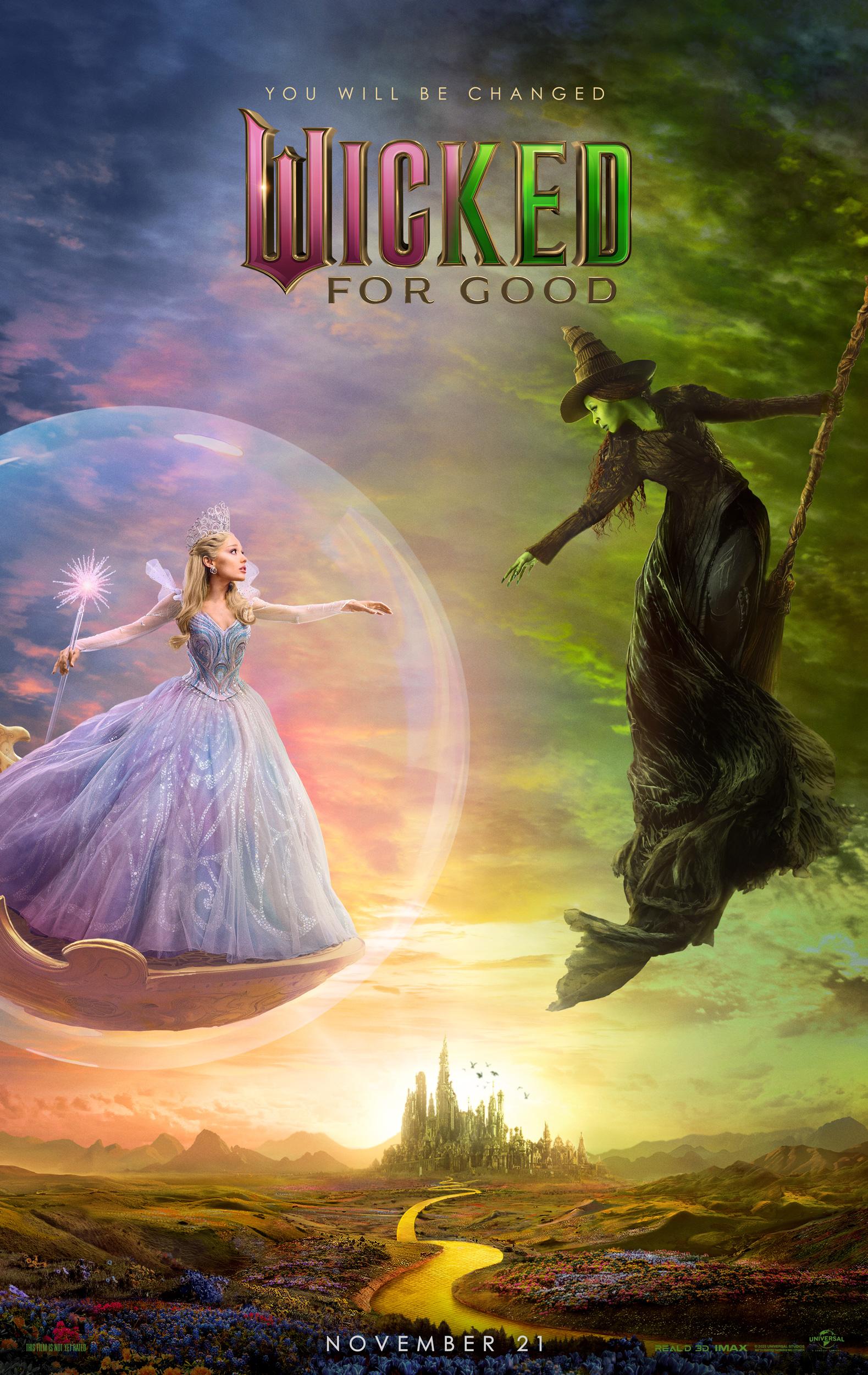
The first part of the Wicked movie was a resounding success, earning itself accolades at the Golden Globes and 97th Academy Awards. Among these were Best Achievement in Production Design, Best Achievement in Costume Design, Best Edited Feature Film – Comedy, Theatrical, and Best Director (IMDB). Since the first movie’s release in 2025, it has kept itself at the forefront of the media and in modern memory, from the trends to Cynthia Erivo’s spot on the cover of GQ’s magazine 2025’s Man of the Year Awards. Wicked: For Good was highly anticipated due to the first film’s success. But despite it being an adaptation of an adaptation of a story (The Wizard of Oz), they made some notable changes from the musical and book. This review will discuss those changes in particular and if they were for the better so turn back now, for there are spoilers ahead!
Wicked’s filmography as a whole is a marvel of technicality. Creativity and passion pour from every facet of the production even to things behind the scenes regular theatre-goers may not understand the effort of. Storytelling drifts through even the set design — the nine million flowers grown by a local farmer for Munchkinland, the CGI Emerald City, and a very real 20-foot-tall mechanical automaton that works via hydraulics to form the so-called “wizard” in his most intimidating form (Elle Decor). On a comparatively smaller scale, the costumes were just as opulent. Glinda was often dressed in layers upon layers of tulle and sequins to mimic her bubbly and naive personality, while Elphaba was given more strong silhouettes in the sequel as a testament to her newfound sense of power. According to costume designer Paul Tazewell, he showed the change in the characters very subtly. Elphaba wears remnants and reminders of her visit to Emerald City and the cloak Glinda gave her in later costume (Harper’s Bazaar). This hints to how Elphaba still keeps Glinda close to her heart while still recognizing both their growth as individuals.
Just like the first installment, Wicked: For Good boasts a fantastic soundtrack both vocally and instrumentally. Songs carry remnants of previous songs, an elusive clue to the viewer of Oz’s ever-changing landscape. For example, the opening number “Everyday More Wicked”, while also referencing the original “No One Mourns the Wicked” and a bit of “Popular”, has a small portion of notes that were featured in “One Short Day”. These small details in the music are only truly heard after a couple listens (or unless you’re a nerd like yours truly) but speak to the detail interwoven throughout every aspect of the movie and staged versions. However, the movie adaptation did change some things musically that may have been a surprise to those that have seen or listened to the original musical’s songs. The two songs added were “No Place like Home” and “The Girl in the Bubble”.
As a theatre kid and someone who watched the musical live, I am likely a bit biased when it comes to these new songs written especially for the movie. Despite Ariana Grande and Cynthia Erivo’s amazing voices, these songs felt rather needless. Most songs in musicals serve the purpose of expressing emotion or driving plot – a character must be feeling something so strongly that spoken words alone will not suffice and they must sing. Neither of these songs served this purpose, rather conveying things the audience could just as easily draw from the characters, their expression, and the actions they take. “No Place Like Home” does outright acknowledge that the land of Oz is also home to the animals and the unfairness of how their treatment has led the animals to run away instead of fighting for the rights they deserve. The song reminds the audience that the animals do belong in Oz, but it ends up being a rather weak rallying cry when put in comparison to similarly positioned songs like “The World Will Know” in Newsies or “Do You Hear the People Sing?” from Les Misérables. “The Girl in the Bubble” is the better of the two by quite a bit, capturing both the feelings of Glinda herself and the pressures put upon her by Oz’s expectation. While the song itself breaks the tension of the movie, it also gives the audience more of an insight into the life of Glinda, something that was not seen prior to the song.
Outside of the extra, unneeded songs, Wicked: For Good also made another large change in the spell cast upon Nessarose. This change, however, feels more positive. If you’re unfamiliar with the original musical, during “Wicked Witch of the East”, Nessarose specifically asks Elphaba to grant her the ability to walk. To quote her lines in the song, “All of my life, I’ve depended on you / And this hideous chair with wheels / Scrounging for scraps of pity to pick up / And longing to kick up my heels”. This leads to Nessarose standing from her wheelchair and walking for a portion of the time thanks to the magic in her silver slippers. However, the movie adaptation changed this. Marissa Bode, the actor for Nessarose, is a full-time wheelchair user and the inspiration behind the change in the character’s story arc. In the movie version, Nessarose wishes to feel as if she is “floating on air” the way she felt when she danced with Boq at the Ozdust – and so Elphaba’s spell sends her floating, echoing the joy and lightness of that night. While this change received some raised brows online, I thought it was a powerful statement. The original arc could be interpreted as a desire to have one’s disability “fixed”, which might be considered ableist. Wicked: For Good’s take shows how real wheelchair users can be featured in the role and how Nessarose is not inherently “broken” due to her disability.
As a movie adaptation, Wicked: For Good did a good job at encapsulating the message of the original musical: no one is truly “wicked” and even the most perfect seeming people may not truly be so. I immensely enjoyed both parts of the movie and the actor’s interpretations of the characters. Just as with the original film adaptation, I hope that Wicked: For Good encourages more people to support their local theatrical communities. So much thought, effort, and time goes into the creation of what appears on stages and screens without much acknowledgement. Both Southwestern and Georgetown at large have amazing theatrical productions one can go see at little to no cost, which I highly recommend if you found any part of this article interesting. Southwestern University is putting on BKLYN The Musical February 20-22 and 27-28, and March 1 and the local Palace Theatre puts on several performances a year. To learn more about there, check out the Current Season at the Sarofim School of Fine Arts and the 2026 Season at the Palace Theatre.