
Fanon & Philosophy: A Centenary Retrospective

Share

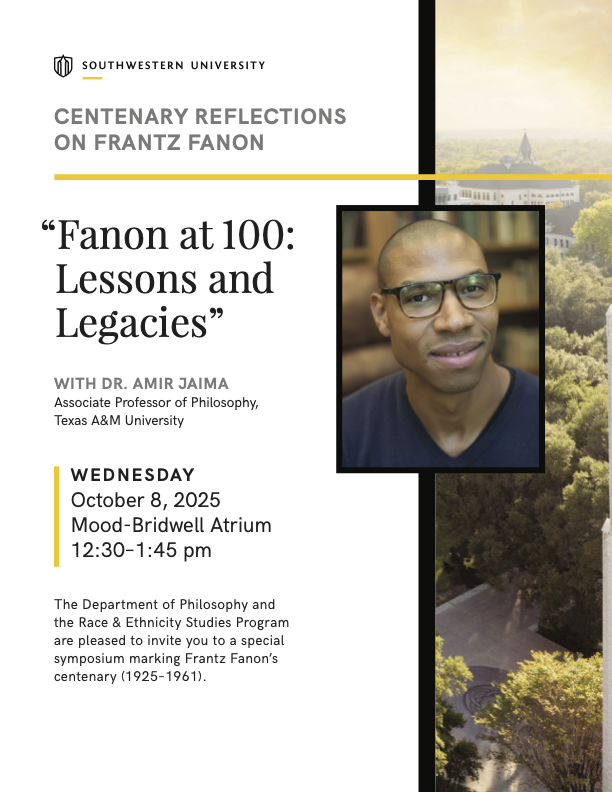
Last month, one of the most important philosophy and social justice conferences of the semester took place. To commemorate the centenary of the birth of Frantz Fanon (1925-1961), an important French figure in the field of psychiatry and political philosophy focused on the study of segregation and colonialism, the Department of Philosophy and Race & Ethnicity Studies decided to host a talk on Fanon’s ideas. This event was divided into four chapters throughout that Wednesday, starting at 12 p.m. and ending at 7 p.m.
The first part of the event, “Welcome and Opening Remarks,” presented the highlights of Frantz Fanon’s life and what led him to become involved in politics and psychiatry. In this opening presented by Dr. Zinhle ka’Nobuhlaluse, assistant professor of philosophy, she recounted Frantz Fanon’s activist efforts as a writer to raise awareness about the psychological and social consequences of colonialism and racism on colonized populations. Ka’Nobuhlaluse describes Fanon’s influences on postcolonial studies and black liberation, while also relating Fanon’s ideologies to her life as a South African who experienced the effects of post-apartheid in her childhood and adolescence to justify her activist efforts for social justice and her special participation in presenting this talk.
Following this brief introduction, a special guest led the remainder of the first hour of the event. Dr. Robyn B. Adams, Mellon Resident Scholar in Humanities Engaged in Social Justice (Southwestern University); Adjunct Professor of Advertising and Brand Strategy (Texas Tech University), served as a speaker to complement the data presented by ka’Nobuhlaluse. Adams presented their involvement as a resident activist at Southwestern University, their recent research on reproductive justice here, and their inspirations drawn from Fanon’s work. After a brief introduction to herself and her work on campus as a Fanon follower, Adams gave way to the keynote speaker, Amir Jaima, to continue the rest of the symposium.
Dr. Amir Jaima, associate professor of philosophy at Texas A&M, immediately moves on to the second part of the event, “Keynote Address.” In a presentation lasting just over an hour and fifteen minutes, Jaima, in his presentation “Fanon at 100: Lessons and Legacies,” presents two main lessons from Fanon based on his book Black Skin, White Mask, which question the identity of both white and black communities about themselves and how they distort their own identities. At the end of this informative reflection, a question-and-answer session further explored these two parts of the event. Together, these two chapters lasted approximately from 12:00 p.m. to 1:45 p.m., with the next section starting at 4:00 p.m. after a break of almost three hours.
The third part of the symposium, “Afternoon Panel”, began with José Alfredo Ortiz Ángeles, PhD Candidate in Philosophy (Texas A&M University), reflecting on Frantz Fanon’s philosophical legacy in social justice. In his presentation, “Frantz Fanon: The Future Lasts Forever,” Ortiz Ángeles emphasized Fanon’s contributions in the aforementioned areas of psychiatry and black liberation as one of the first theorists to predict the consequences of racism and colonialism today as a source of dehumanization for both the colonized and the colonizers, now divided black and white communities. Reflecting on how Fanon has inspired new generations to fight for equality in a world that is no longer institutionally, but rather socially segregated by racism, Ortiz Angeles was relieved by Southwestern University Philosophy alumnus Nick Baylor to speak about art and music influenced by Fanon in his presentation “Fanon, Art, Media”.
This third course concluded with personal reflections from Southwestern University undergraduate student Raven Waugh, presenting her journey studying Frantz Fanon in “Carrying Fanon Forwards: What Fanon Means to Me.” As the title of the presentation suggests, Waugh explained how Fanon’s ideas and work have aided her in better understanding her studies in race and ethnicity, and how they can also help us to comprehend our current social justice events. In a series of short but deeply thoughtful speeches, this third session wrapped up in just one hour, showcasing how Frantz Fanon has influenced the lives of many of us without us even realizing it. From historical events to social movements that still shape our daily lives, this symposium invites us once again to reflect on the impact of Fanon’s ideas on contemporary society.
The fourth and final event of the Frantz Fanon centenary, “Film Screening & Discussion,” (5:30 p.m.-7:00 p.m.) featured the documentary Concerning Violence as the topic of discussion to close this carnival of reflection. In both phases of this chapter, the African liberation between 1960 and 1970 discussed in the film showcases the purpose of this commemoration and its contributors: progression. Concerning Violence, based on Fanon’s essay of the same name, is a critique of the violent structure of colonialism and its stagnation in history. As Fanon suggests in both works, the way to eliminate and overcome colonialism and its racism is, once again, through a violent revolution. This symposium, rather than unquestioningly accepting these ideas, attempts to philosophize and understand the reasoning behind them.
Personally, this event has been invaluable, giving me a chance to think, at least for one day, about how the surrounding ideas affect us and how to make a difference in an era as frenetic as ours, to help us delve into the mental process of a philosopher. Since that is how philosophy works—slow and focused—because, even if only for a day, it is what we often need as people to meditate and progress in our lives, just as we must progress as a society. The centenary of Frantz Fanon is presented to us mainly to commemorate Fanon, but also to commemorate the process of philosophical thought, because it is with this framework that the speakers invite us to reflect on this event.