
The Power of Black Storytelling: Jessie Daniel Ames Lecture With Stacie McCormick

Share

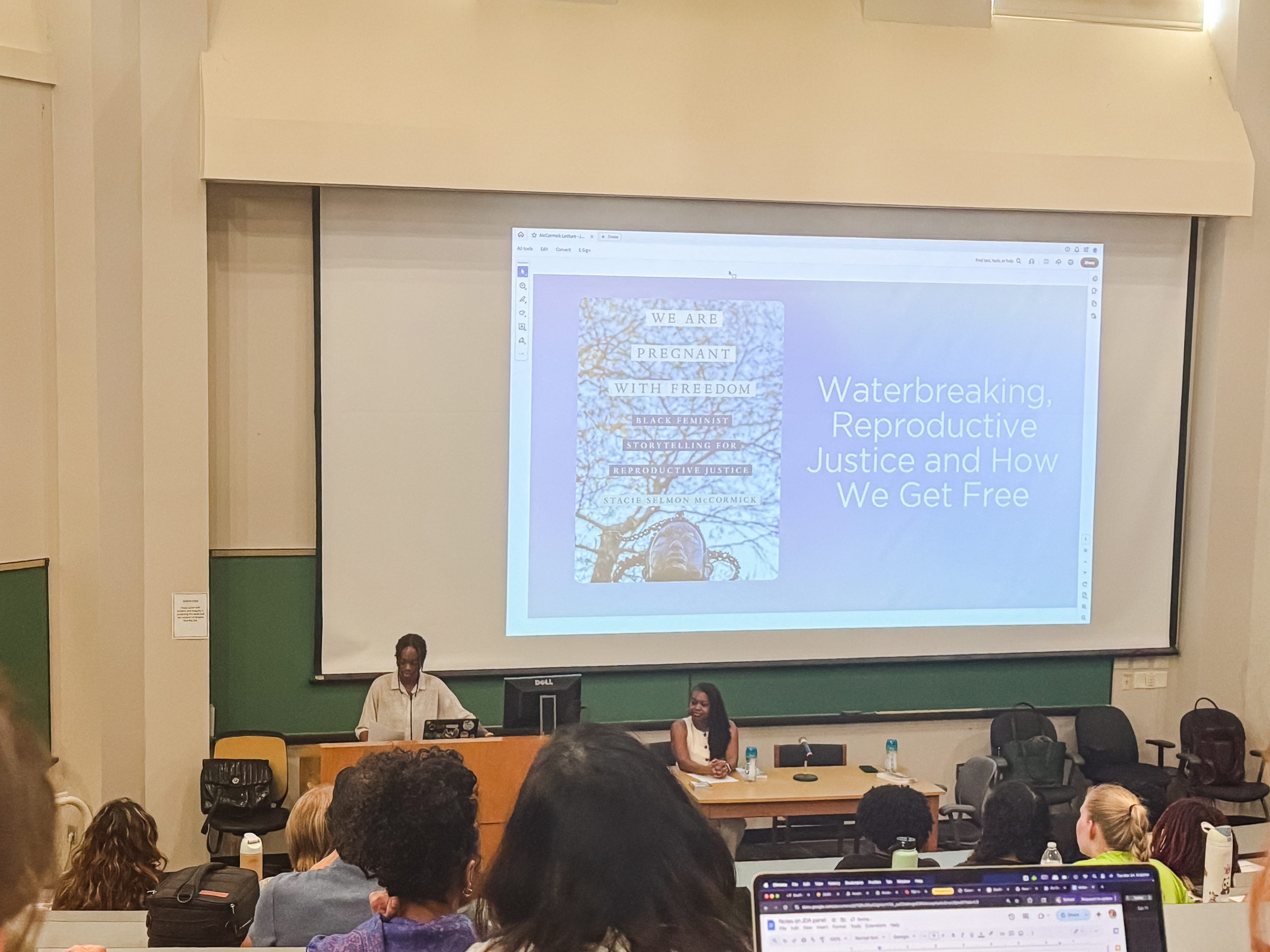
The Jessie Daniel Ames Lecture is a long-standing Southwestern tradition, notably named after the abolitionist, suffragist, and Southwestern alum. The Lecture, sponsored by the Feminist Studies department, is an annual invitation to scholars and activists to share their experiences and community work, as well as discuss feminist thought with students and faculty. The JDA Lecture is an esteemed event, with notable past speakers including bell hooks and Gloria Anzaldúa.
This year, the Feminist Studies department hosted Dr. Stacie Selmon McCormick as the 2026 JDA Lecture speaker. Dr. McCormick is an Associate Professor of English and Department Chair at Texas Christian University. Her topic was surrounding her book, “We Are Pregnant With Freedom: Black Feminist Storytelling for Reproductive Justice,” which is a multi-narrative book on the liberation of reproductive justice. The book includes many reflections of the frameworks of Black reproductive justice scholars, as well as many histories and experiences, including those of Dr. McCormick and many other community members that she worked with through her storytelling project, “Livable Black Futures.” Livable Black Futures is a project that was founded by Dr. McCormick in collaboration with the Affiya Center; the project on seeking care and reproductive justice freedom for Black folks in the community. Livable Black Futures works to connect full-spectrum doulas, social workers, and therapists with members of the community who may be experiencing AIDS and incarceration, and also seeks to help birthing folks and womb holders.
Before Dr. McCormick began her lecture, she was introduced by Scholar/Activist in Residence, Dr. Robyn Adams, and Assistant Professor Dr. Meagan Solomon. In Dr. Adams’ introduction, they spoke about how Dr. McCormick was their introduction into reproductive justice. When speaking about her framework for “Livable Black Futures,” Dr. Adams stated, “She is life, she is imagination, she is care.” Dr. Solomon also expressed her gratitude, acknowledging Dr. McCormick’s participation on the dissertation committee that granted Dr. Solomon’s PhD.
Dr. McCormick also took a minute to acknowledge her rich history with the two professors, expressing, “It is full circle to be here with Dr. Adams and Dr. Solomon. You give me so much hope, and make me see that everything is going to be okay.”
LG Riley and Lillie Pearl Selmon were among several people that Dr. McCormick hailed at the start of the lecture. These two women are Dr. McCormick’s grandmothers, and she attributed her black feminist education to them; she also noted the work of activists Assata Shakur and Anarcha Lucy Betsey. Dr. McCormick spoke on the erasure and consolidation of many departments and majors at universities across the country, including her current place of employment. In spite of everything happening within academia in America, Dr. McCormick has continued to sow her faith into education and community building. She stated, “Even though my reality is difficult, there are still spaces of possibility.” These spaces of possibility are brought by way of storytelling, which is one of the key points of Dr. McCormick’s book.
In We Are Pregnant With Freedom, Dr. McCormick uses the term “waterbreaking” as a way to explain the critical act of storytelling as an opposition to silence. Waterbreaking is defined as, “an outpouring of story from those who have experienced silencing and being unheard due to marginalization of various kinds. The sharing of these suppressed narratives makes space for creativity, exploration, and healing.” She goes on to explain how Black storytelling is on par with the force of water in terms of how cleanses and the power that it holds. Dr. McCormick also sees the motif of water in the realm of childbirth, especially in her own experiences in which she was pregnant three separate times, and never experienced her water breaking on her own volition. The healthcare system mistreated both her physical and mental states, which is a common pattern in the experiences of Black womb holders and birthing folks.
Dr. McCormick went on to share the testimonies of those that she worked with in “Livable Black Futures.” These folks have suffered at the hands of the system in many different ways, including the policing of Black childbirth, mistreatment of birthing folks in the incarceration system, and a general lack of food and access resources. One member, who remained anonymous, stated that, “People are often forced to do risky things for food (sex work, theft, etc) and when you do seek help, you are subject to judgement.” These experiences highlight the overall need for spaces that not only are tasked with making resources more accessible, but also destigmatizing the notion of needing help. Dr. McCormick’s work in sharing and building community with them is something she called “collective waterbreaking.” She states that collective waterbreaking makes space for healing and freedom.
To conclude, Dr. McCormick spoke with Dr. Adams about creating community and giving critical care looks like in this context. “We need to center them,” said Dr. McCormick when asked about incarcerated birthing folks. The most important thing to do is to work top to bottom, first platforming those who do not otherwise have a voice to advocate on behalf of themselves. It is crucial to understand that justice for others and the betterment of the system will always impact everyone positively. Dr. McCormick also gave some advice to students that would like to begin doing this critical work, noting the importance of not doing it alone and finding ways to personalize their work. She also stated the reality of battle fatigue; and that when someone is constantly spending their time fighting and working, it is extremely important to prioritize self care. She stated, “The goal is to exhaust us; if we don’t care for ourselves we can hurt people”
Dr. Stacie McCormick gave an incredibly moving and educational lecture about the importance of Black storytelling and reproductive justice. Dr. McCormick also ensured that her book, We Are Pregnant With Freedom, was free and accessible online to all who wish to read it.