
Christ in the Capitol: Religion as a Political Tool

Share

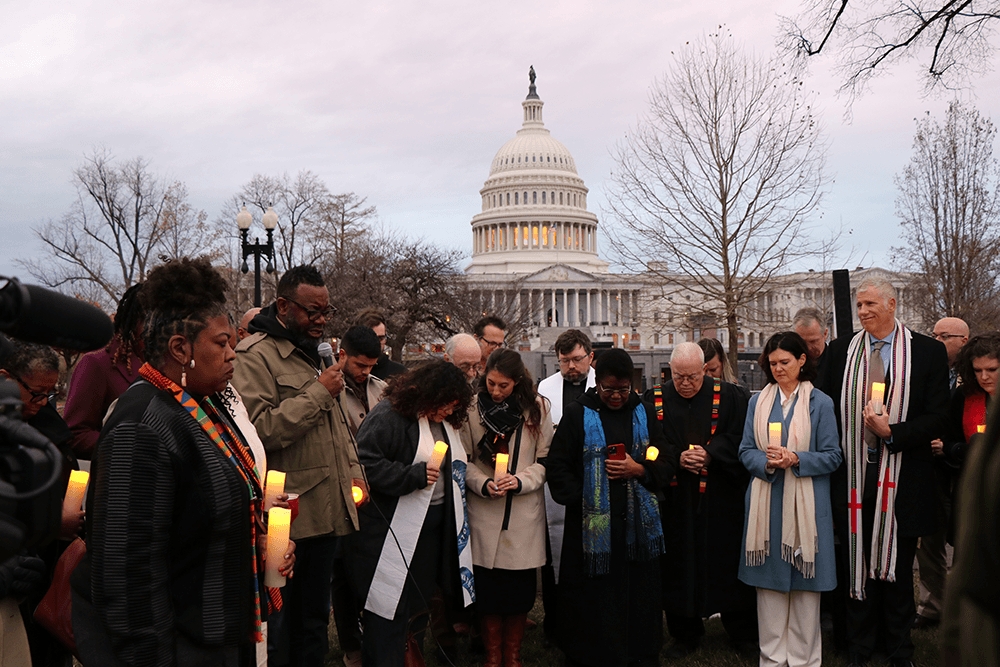
According to the Pew Research Center, 62% of U.S. adults identify as Christians. Whether Evangelical Protestant, Catholic, Lutheran, or any of the other 45,000 estimated denominations, Christianity as a religion has played a significant role in the shaping of the world and the United States of America itself (Gordon-Cornwell Theological Seminary). While seen throughout the world, no place is Christianity’s impact more noticeable than here in the States. From the pledge of allegiance to lawmaking to war and beyond, the research presented here intends to give a “snapshot” of how Christianity is being used as a tool for political gain, and how it could be used differently.
This article is not a direct criticism of Christianity itself, rather a survey and study of how it is being used in relation to current and historical events in the United States of America.
Legislation
Despite modern interpretations, the Constitution and Declaration of Independence, alongside other older political documents, align best with ideas of deism. Deism, as followed by founders of the United States like Thomas Jefferson, believes in the existence of a higher being that created the world but does not interfere (Encyclopedia Britannica). In this way, it was up to the people to better their lives for themselves rather than waiting on an all-powerful being to step in. Also known as the “religion of nature”, deism struck a balance between the Christianity of the 1700s and the newly forming sensibilities of the Enlightenment. Freethinking Europeans were drawn to the belief, finding in it a place to criticize the church as Deism encouraged (National Humanities Center). As a belief that prides itself on being skeptical of religion, the largely Deist founders of America set it up under beliefs that church and state should be separate and later added the 1st Amendment, which assures that no religion will be forced or preferred over another.
In more recent administrations, the claim has been made that America is a “Christian nation”, founded upon Christianity’s moral compass and therefore legislation should align with such beliefs. But the conversation about America’s religious alignment can be dated back even further to the Supreme Court case of Holy Trinity Church vs United States in 1892. While not truly covering the conversation of America as a so-called “Christian nation”, the statements made by Justice David J. Brewer continue to circulate as an argument for Christianity in politics. In his 1905 book The United States: A Christian Nation, he elaborates that “In fact, the government as a legal organization is independent of all religions. Nevertheless, we constantly speak of this republic as a Christian Nation—in fact, as the leading Christian Nation of the world.” Going back to statistics released by the Pew Research Center, most Americans think the US is intended to be a Christian nation and about 4 in 10 think the US should be a Christian nation. Additionally, it has been shown over time that the Supreme Court and other such entities in power consistently protect Christians and Christian Nationalists. In a 2000 research article published by the University of Miami, author Caroline Mala Corbin examined sociological evidence supporting this claim that the Supreme Court upholds and may even facilitate White Nationalist ideals (University of Miami).
Under President Trump, two major collectives were established under the pretense of bettering the lives of Christians, these being the Task Force to Eradicate Anti-Christian Bias and the Faith Office. The former of the two, the task force, was established February 5th, 2025. The presidential action accuses the previous administration of targeting peaceful Christians whilst ignoring anti-Christian offenses. It alleges over 100 acts of violence, theft, or arson against Catholic churches, charities, and pro-life centers and 8 times more acts of vandalism against Christian churches than 2018 (The White House). However, further research uncovers such reports on statistics largely being spread by parties who would benefit from fears over rising anti-Christian sentiment. The most cited source about alleged anti-Christian actions is a report from the Family Research Council, an American evangelical non-profit activist group. This is not to say that these concerns are not valid, but it may take research from less biased organizations to convince some.
Additionally, Trump also established the White House Faith Office February 7th, 2025. Although not naming the Faith Office as a Christian-only organization, the executive order signed by Trump only cites the Office’s duties to combat “anti-Semitic, anti-Christian, and additional forms of anti-religious bias”, failing to outwardly name other beliefs that suffer anti-religious bias (The White House). Also under the Faith Office lies the Religious Liberty Commission, which underwent suit in 2026 from Americans United. The Religious Liberty Commission, as described by the Department of Justice, is meant to aid in addressing lawsuits regarding the First Amendment or other religion-related claims. As alleged by Americans United and Democracy Forward, the lawsuit occurred on behalf of a diverse group of faith organizations that believe the commission was biased in its makeup (Americans United). There is no recent news regarding the state of the suit, but it is important to understand the religious makeup of both organizations started by President Trump – both of which are dominated by white Christians.
Political Campaigns
Religious affiliations and beliefs are also intertwined with the vernacular and running grounds of political campaigns. For this, we will be looking at the campaigns of two different but equally vocal candidates separated only by time: George W. Bush and James Talarico. While often leaving the specifics vague, George W. Bush is considered one of the most vocal Christians to hold a seat in the Oval Office (NBC). In a New York Times article detailing Bush’s 2000 campaign, he is described as turning not only to campaign consultants and briefing books, but also to the words of the Bible and preachers like James Robinson. Bush also wrote that his mother, while listening to Reverend Mark Craig’s sermon about the reluctant leader figure of Moses, later told him that the minister was talking about him specifically. Later, Bush would attribute his run for presidency to this same sermon (New York Times).
Nowadays, religious language can still be found in the campaigns of politicians like James Talarico, who is currently running for Senate in Texas. The following is from his official website: “I’m a Presbyterian seminarian studying to become a pastor. My faith in Jesus leads me to reject Christian Nationalism and commit myself to the project of democracy. Because that’s the promise of America: a democracy where every person and every family — regardless of religion, race, gender, sexual orientation, or any other difference between us — can truly be free and live up to their full potential” (James Talarico – Freedom, Family, and Faith). While more vocal about how his Christian beliefs would affect his policies than Bush, both Talarico and Bush are prime examples about how vocal Christianity in the political campaign space is not only normalized but rather effective. While this remains unproven by credible sources, it is likely that this sort of political campaign based on religion is accepted because of the power of Christianity in America, whereas running on other Abrahamic religions like Islam or Judaism may not garner the same reaction.
Colonialism and War
The U.S. has long used religious arguments and imagery to justify its colonialist and warmongering tendencies. Take Manifest Destiny for example, the 19th century belief that America was divinely ordained to expand westward to the Pacific, and even beyond it. This led to Native American populations becoming further displaced, Hawaii being colonized, the Mexican-American war, and the Spanish-American war (Manifest Destiny | Summary, Examples, Westward Expansion, & Significance | Britannica; Culture, Colonization, and Hawai’i’s History). Today, we see religion once again playing a role in justifying war, particularly dispensationalist theology in America’s war with Iran. Dispensationalism is an evangelical tradition of theology based on the belief that history is divided into seven epochs—or “dispensations”—which culminates in a rapture of all believers prior to a period of tribulation lasting seven years. Other pertinent tenets of dispensationalism are that promises given to the nation of Israel in the Old Testament must be fulfilled with the nation of Israel today and that Israel has its own special future ordained by God. Dispensationalists argue that God will restore Israel and that it will lead and serve the Gentile nations during Jesus’ thousand-year reign (Dispensational Theology – The Gospel Coalition). Dispensationalism has its roots in the late 19th century as a potent American re-vitalization of Christian Zionism and shapes much of America’s attitude toward Israel, Palestine, and the Middle East today (The Armageddon Lobby: Dispensationalist Christian Zionism and the Shaping of US Policy Towards Israel-Palestine).
For dispensationalists today, wars in the Middle East are signs of Armageddon and Christ’s imminent return. This dispensationalist rhetoric has been welcomed wholeheartedly by the U.S. Department of Defense. (End-times rhetoric in US military ‘didn’t infiltrate, was invited in’ | Cornell Chronicle). U.S. Secretary of Defense Pete Hegseth continues to invoke this rhetoric, as he publicly prayed for the “wicked souls” in Iran to be subject to “eternal damnation” (Hegseth injects combative Christianity into America’s military). Of course, dispensationalism is but one strand of Christianity, and anyone who has read the Bible thoroughly should be suspicious of the use of Christ to justify war. After all, “He who lives by the sword, dies by the sword.” Moreover, in a fitting rebuttal to Hegseth’s grotesque prayer, Pope Leo XIV said that God does not answer the prayers of those whose hands are “full of blood” and rejects the use of Christian rhetoric to justify war (Pope seems to rebuke Trump in remarks about leaders with ‘hands full of blood’ | Pope Leo XIV | The Guardian; Pope Leo Says God Rejects Prayers of Leaders Who Wage War | Reuters).
Can Only The Right Talk About Armageddon?
There is more to the story of apocalyptic theology than a relatively recent strand of American Christian war zealots. While apocalyptic theology is often associated with right-wing politics, there is a relatively unknown tradition of radical leftist apocalyptic theology. For starters, Christianity itself has its origins in an apocalyptic Jewish sect called the Essenes. These were messianic Jews who anticipated the coming of a savior who would heal the sick, raise the dead, and overthrow the powers of the world. Early Christianity added to these teachings that such a messiah figure has already appeared in Jesus Christ, and that his return would come incredibly soon. In anticipation of this return of Christ, early Christian communities (like the Essenes) organized themselves communistically, renouncing private property and peacefully subverting the power relations of the Roman empire(Essenes: The origins of Christianity lie in this ancient Jewish sect | The Jerusalem Post).
Of course, Christ did not return immediately, and Christianity went on to become the institutional and universal religion we know it as today. However, throughout history, there have been more pockets of eschatological fervor which brought about radical political engagement. For example, there were the Millenarian movements. Millenarianism is the belief in a cataclysmic, divine apocalypse which overthrows the current world order and ushers in a utopian kingdom of peace (Millenarianism (Millennialism) – Hartford Institute).
This broad belief has been associated with several radical religious movements throughout history, one prominent example being The Brethren of the Free Spirit. This was a movement within Christianity originating in the 13th century which centers on a radical interpretation of 2 Corinthians 3:17. The verse reads, “Now the Lord is the Spirit, and where the Lord’s Spirit is, there is freedom.” As philosopher Simon Critchley explains, if the Lord’s Spirit is ‘located’ externally to believers, then in order to achieve salvation, believers must submit to the authority of the Church and Scripture, as well as the authority of the State and Law. But if the Lord’s Spirit is located within believers, then there is no need for the external mediation of the Church, Scripture, and so on; believers can attain salvation without such authority and without waiting on saving grace. This movement thus became the first to formulate the doctrine of mystical anarchism, positing that to be truly free, humanity must embody God within themselves. As Critchley says, “If a community participates in the Spirit of God, then it is free and has no need of the agencies of the Church, state, law or police. These are the institutions of the unfree world that a community based on the Free Spirit rejects. It is not difficult to grasp the anarchistic consequences of such a belief.” (Mystical Anarchism1). Thus, the rhetoric of Armageddon is not just a tool to secure imperialist power; it can also be a weapon against such power. I (Will) often wonder what it would be like if American Christians took up this strand of apocalyptic theology instead of the one which justifies war.
Conclusion
The intention of this article was not to criticize Christianity, but rather to point to the various ways it has been used by the United States government in the past, as well as the ways it is currently being used now. We hope that this article has brought to your attention the various ways Christianity could be used in politics, whether Christ is in the capitol, outside of the capitol, or—perhaps—overthrowing the capitol.