
Forty Years Later, Lonesome Dove Still Wins Hearts

Share


For the 40th anniversary of contemporary author Larry McMurtry’s Pulitzer Prize winning novel Lonesome Dove, the New York Post wrote an article on young women’s rising obsession with the novel. While it sounds like an exaggerated claim, there is a resurgence in popularity for the classic cowboy novel, with weighty evidence to suggest this popularity is being spearheaded by Gen-Z women. In 2024, 40 years after its initial publishing, Lonesome Dove sold 54,000 copies. Both cultural and political influences must be credited. Most critically, a rise in desire for role models of positive masculinity and Larry McMurtry’s insightful depictions of women are an important nod toward its continued success.
Regarding the claim that specifically young women are attracted to Lonesome Dove in more recent years, the evidence stands in modern literature statistics. It is widely believed female readers are not only growing more numerous, but are acting as more prominent voices in literary culture as the 2020s have trudged on. The National Endowment of Arts states that 50% of Generation-Z women identify as readers, in comparison to 28% of men of the same age group. Further statistics on the genre of books read along the gender line contributes to the evidence of female dominance in literature engagement.
In his paper, “Reader and Author Gender and Genre in Goodreads”, researcher Mike Thelwall looked at gender proportion of reviews across genres on Goodreads. He found that across the gender binary, women were most likely to review romance novels in comparison to men, and men most likely to review philosophy in comparison to women. Thelwall found that the largest reviewing gap was with the romance and philosophy genres– 95% of romance genre reviewers identify as female, and some 60% of philosophy genre reviewers identify as male. Even within these two genres, we see that women read a wider variety of genres than men. Furthermore, Thelwall’s paper claimed that men were the minority in genres commonly associated with Larry McMurtry’s work, with 40% of literature, 25% of fiction, and 10% of contemporary reviewers identifying as men on Goodreads.
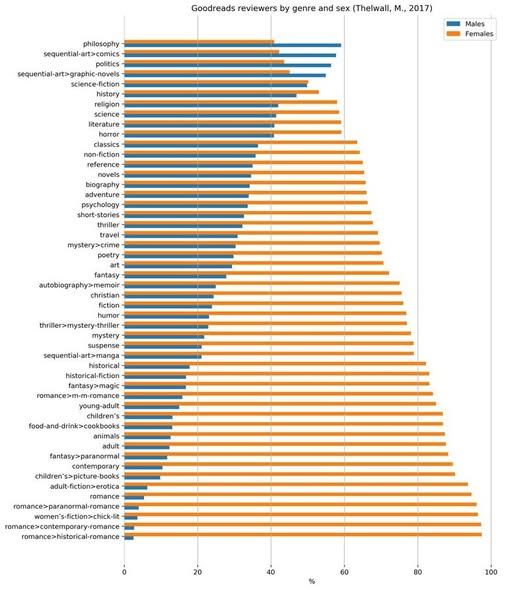
The larger cultural trend of women avidly interested in a range of genres is a foundational explanation for why Larry McMurtry’s work has attracted a revitalized era of young female readers. McMurtry writes both men and women as sources of comfort to young women, which can be separated into two distinct categories. Men act as a source of comfort to female readers by representing honorable, strong masculinity. Women act as a source of comfort by representing the many rich, beautiful forms in which women can exist as.
A multitude of published political studies show the current young generation has never been more politically divided, with young women and men skewing to the left and right sides of the political spectrum, respectively. As young women begin to campaign more for themselves and the respect they deserve in society, they become increasingly intolerant of men who express misogynists views that devalue the autonomy of women, such as ignorance that denys the danger of sexist jokes, rape culture, the glass ceiling, medical inequality, and the existence of femicide, amongst many other critical feminist issues. Larry McMurtry writes men in a way that allows women to put trust in his characters in ways in an era where they fear putting that trust in real men. Bluntly, it is safe to have admiration for McMurtry’s male characters.
I won’t use the word crush, since I don’t believe women’s connection to his male characters comes from that, but rather women grow to have genuine trust in main male characters to be good people, good men—complex with depth, intelligence, and consideration—even if they make fools of themselves or are prone to cruelty on occasion. McMurtry writes of traditional masculinity that centers personal strength, emotional intelligence, responsibility, humility, and often kindness shown to vulnerable groups– such as animals, children, and women. As women witness a modern decline in reliable, admirable men, they seek these qualities in fiction and find a wealth of such in Lonesome Dove.
Further, Larry McMurtry’s immeasurable and profound portrayals of women are shining. His understanding of the deep inner worlds of women leads readers to consider if he has memories of another life as one. Not only does McMurtry present male narratives that do not fall into the eye-rolling literary trope of “author-insert badass hero protagonists”, but he takes serious consideration delivering impressive, flattering insight on his female characters that shows his genuine belief that women are equal, capable, and competent. It is more than evident in McMurtry’s work that his female characters are written to have inner lives just as deep and worthy of the spotlight as the inner lives of his men.In his works, women are not held to conform to patriarchal standards to be treated as equals to men. Women are allowed to be homemakers, allowed to be in the trades, allowed to be emotional, allowed to be promiscuous or conservative, allowed to love or not love at all. McMurtry does not force women to be stone cold femme fatales or heroines to be appreciated and accepted by readers. Women can be women, traditional or not, and there’s no ridicule or rhetoric to represent them as a 2D face either way. Above all else, women are infinitely complex in McMurtry’s work, and you will never read two female characters of his as the same.
The aesthetic of masculinity is exclusionary to women. To read works that include traditional male aesthetics, such as cowboys and the open range is refreshing– it invites the audience, regardless of gender, to join a world of freedom and acceptance. Women don’t have to worm their way into McMurtry’s club for boys, because there is not one. Women accept love from Lonesome Dove without having to beg for it, often coming as a shock due to the begrudgingly accepted tradition of ignoring the sexism of an author to enjoy his work. Larry McMurtry’s men provide traditional masculinity without threat, bad faith, or harm. There is safety in reading McMurtry’s depictions of men that can be trusted. There is a safety knowing Larry saw women in the same way us women do.
Sources (unformatted)
New York Post (2025) “Young women are now obsessed with this 40-year-old cowboy novel”
Mike Thelwall (2017) “Reader and Author Gender and Genre in Goodreads”