
Has TV Turned into Brain Rot? Stranger Things 5, “Second Screen” Policies, and the Postmodern Television Viewer

Share

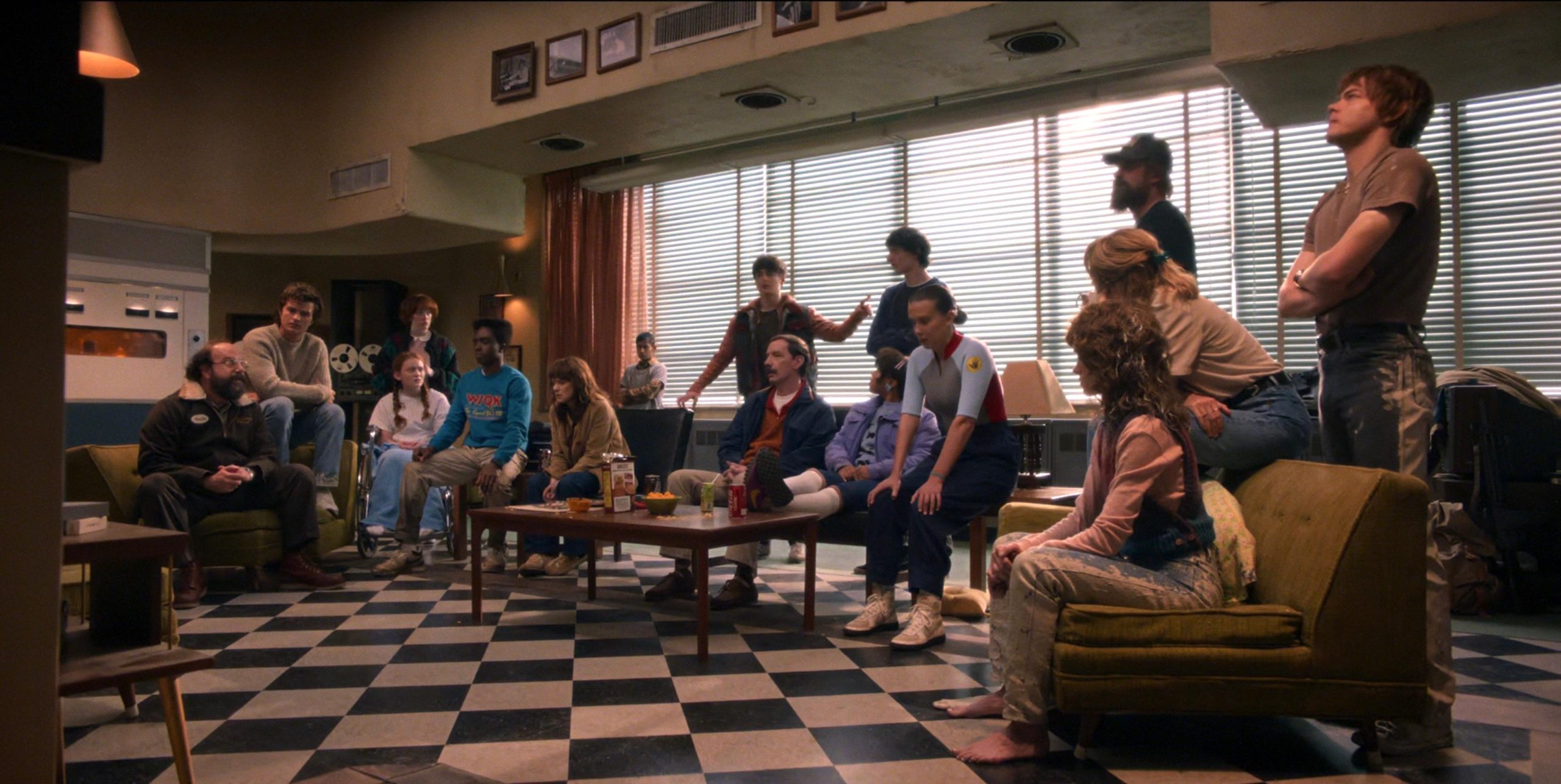
Now over a month since Stranger Things (finally) ended, the aftermath is fascinating. It is not a controversial claim to say that the show’s final season was a disappointment, whether or not one was already disillusioned with Stranger Things after seasons three and four. Season five is a comedy of modern show-running errors, be it the overly bloated cast, the flanderization of pretty much every character (even Steve Harrington himself), the overexplained and nonsensical lore, the lack of stakes, the subpar acting… the list goes on. Since the finale dropped, fans expressed their disappointment in both in-person and online spaces. A documentary dropped which exposed us to the Duffer Brothers’ incompetencies (why they chose to release this, no one knows), and there was even an online conspiracy theory—#ConformityGate—about a secret ninth episode releasing on January 7th, causing Netflix’s servers to crash that night from believers flocking to see this alleged “true finale”. As film critic James Crooks put it in an article, it was a “hilarious coping mechanism for those left unhappy with the show’s ending.”
I am not writing to completely rehash critiques of Stranger Things’ most hated season, however. I am more curious about why and how the season’s flaws came to be. And to answer those questions involves looking into the corporate policies which shaped the way the Duffers wrote this season. While I am not suggesting that the Duffers were enslaved to the whims of Netflix’s executives, I also don’t think insistence by said executives on their awful policies helped the Duffers much. This is not a Game of Thrones situation, where blame for a terrible ending can be put solely on the showrunners. The Duffers are still partly to blame, but thankfully for them, they are not alone.
To end this preamble and get to the matter at hand, the problem plaguing the last season of Stranger Things—and other Netflix shows—are the company’s “Second Screen” Policies. Have you ever watched a show or movie with friends, and one or more people get distracted and look at their phones? I know I have, and I know I also was the person to look at their phone. Well, Netflix is well aware of the society of inattention we are currently living in, and has begun implementing “Second Screen” policies, meant to take into account the fact that people will actually have Netflix shows in the background as a “Second Screen” while they scroll on their phone or computer. The policies thus encourage showrunners to write—among other things—far more exposition than needed for a show; scenes where characters announce what they are about to do and/or explain their intentions in detail that help distracted viewers follow along.
Now, it would be premature and irrational to denounce this as the “end of prestige TV” as some have. One can still find plenty of substantial, engaging TV shows on streaming sites, whether on Netflix or beyond. Shows like Pluribus, Severance, The Pitt, and more prove that contemporary television is not lacking in substantial content. However, it’s hard not to be worried—and frustrated—by this development in TV production, and how it accommodates rather than discourages the current malaise of our time: inattention. Postmodern capitalist society is profoundly inattentive, or rather, it is a society in which attention is endlessly split, deferred, and mined for profit. Despite psychological evidence that we humans do not multi-task well and that our overall health improves with attentive practices, companies continue to encourage division of our attention between different activities, because it profits them.
How so? Well, for one, dividing our attention between social media and TV watching ensures that both social media companies and streaming sites remain growing, even if that growth requires that we become mindless automatons. Secondly, we humans tend to like brain-numbing activities; they provide easy escapes from the hardships of life, no matter how minute those hardships are. Obviously we are still capable of enjoying good art, and it’s not as if no pieces of media achieve both commercial and critical acclaim (think of the Beatles’ music or Breaking Bad). However, the main trend we see is that mindless entertainment rakes in far more profits than mindful entertainment (compare the box office numbers of Illumination movies to Dreamworks ones to see my point). Thus, companies continue to divide our attention endlessly, because it leads to economic “growth”.
Some describe this phenomenon as the “hyperactivity” or “acceleration” of postmodern society. But this fails to fully capture the depth of the problem. Philosopher Byung-Chul Han, in his novella, The Scent of Time: A Philosophical Essay on the Art of Lingering, writes of postmodern time:
What causes the shrinking of the present or the diminishing duration is not, as we erroneously tend to believe, acceleration. The relation between the loss of duration and acceleration is much more complex. Time rushes away like an avalanche exactly because it is no longer fastened within itself. Those points in the present, among which there no longer is any temporal gravitation, cause the tearing away of time, the aimless acceleration of processes, which is no longer an acceleration because it lacks direction. Acceleration, in its proper sense, requires trajectories with direction.
True attention requires time to be “fastened” or tied down to particular people, events, objects, etc. Postmodern capitalist time creates a directionless present which seeks stimulation without purpose. It is attention without attention. So, the problem is not just hyperactivity, but hyperactivity that goes nowhere.
Netflix’s second screen policies contribute to this malady rather than discourage it, and Stranger Things 5 is evidence of this. Dialogue in Stranger Things 5 exists primarily to be expository and/or to deliver cheeky one-liners; it lacks character depth and growth. Take the character of Lucas for example, whom I enjoyed watching quite a bit in season four. This season he is reduced to giving exposition or making quips. One can also point to Will Byers’ now infamous coming-out scene in the second to last episode, a scene which frustrated both straight and queer fans alike. The fact that this long-delayed expository scene was placed as the emotional climax of the penultimate episode of the show is already evidence of poor story structure. But the scene takes forever, beating around the bush so much that it begins to dig a moat around the entire thing. It has to make it very clear what is going on so you can follow along while scrolling on Instagram. Not to mention that the amount of scenes which feature the characters giving exposition in the fictional SQWK radio basement is into the double digits, and there are more exposition scenes besides. It is mind-numbing.
Granted, it is difficult to give characters deep, adequate storylines when your cast of characters is so large. But the solution isn’t to just be apathetic about character arcs, as the Duffers seem to have been. Many people came into season five heavily invested in the show and its characters, and even those who held low expectations going into it, like myself, still wanted something well-written. The few emotional throughlines there were were just rehashings of storylines already resolved in previous seasons. For example, Hopper being overprotective of Jane was a flaw Hopper already confronted and acknowledged in season two—and in one of my favorite scenes of dialogue in the show to boot—but for the sake of giving these characters something to do, it is played out again here, without any of the gravitas it possessed the first time.
I could go on and cite more examples, but I imagine that if you watched the final season, you could come up with more yourself. And indeed, it only takes a quick Google search to see how legions of fans have already raised similar complaints. This is a hopeful sign in many ways; the fact that many people are already resistant to the dumbing down of television for profit. But of course, as long as it remains profitable for streaming companies to do this, heck, as long as profit-seeking is the initiative of our economic system, it is hard to see how this trend in television production will abate.
Philosopher and novelist Albert Camus remarked in his Nobel Prize acceptance speech that consumer society “can be defined as a society in which objects disappear and are replaced by symbols.” TV shows produced like Stranger Things 5 allows the postmodern viewer to abstractly say they “watched a show” without having actually given true attention to the show itself. They can symbolically watch it, which is a lot less demanding. If TV is to maintain its substance as an art form in the future, executives and creators need to refrain from making shows which cater to the postmodern TV viewer. Thankfully, as I have mentioned earlier, there are a good handful of shows today that do not do this. I mentioned Pluribus earlier, and this show in particular represents a wonderful counter-movement to “second screen” policies. Created by Vince Gilligan, the creator of Breaking Bad and Better Call Saul, Pluribus follows a miserable woman, Carol, who finds herself in a world where everyone else is infected by an alien parasite… with happiness. It is an odd show (in the best way!) which is unafraid to linger, both in its cinematography and in its story structure. It takes its time, and does not explain everything in dialogue. One must look carefully at what the show emphasizes on the micro-level—be they props, setpieces, facial expressions, and more—to actually absorb the story more fruitfully on the macro-level. It rewards truly attentive engagement; it rewards those who do not just watch TV symbolically.
So… watch Pluribus (it’s on Apple TV+)! More broadly and more importantly, do not support “second screen” policies and the dumbed-down shows they produce. Platforms like Apple TV+ and HBO Max tend to avoid this trend, so I would recommend starting there. Additionally, you can be on the lookout for the upcoming Megaphone TV show recommendations article! We know good TV shows from bad ones… definitely. As a final clarifying note, when I advocate for more engaging TV, I am not saying that every show must be deep and/or complex. Sometimes a show can just be simple fun. But there is a difference between comfort shows and TV brain rot. One gives you rest; the other numbs you. One leaves you in control of your attention; the other divides it for profit. Disgruntled fans of Stranger Things who had to endure yet another long exposition scene featuring 15+ characters cramped in the basement of a fictional radio tower will understand this better than anyone.