
Researcher Feature: An Intersectional Feminist Journey with Dr. Meagan Solomon

Share

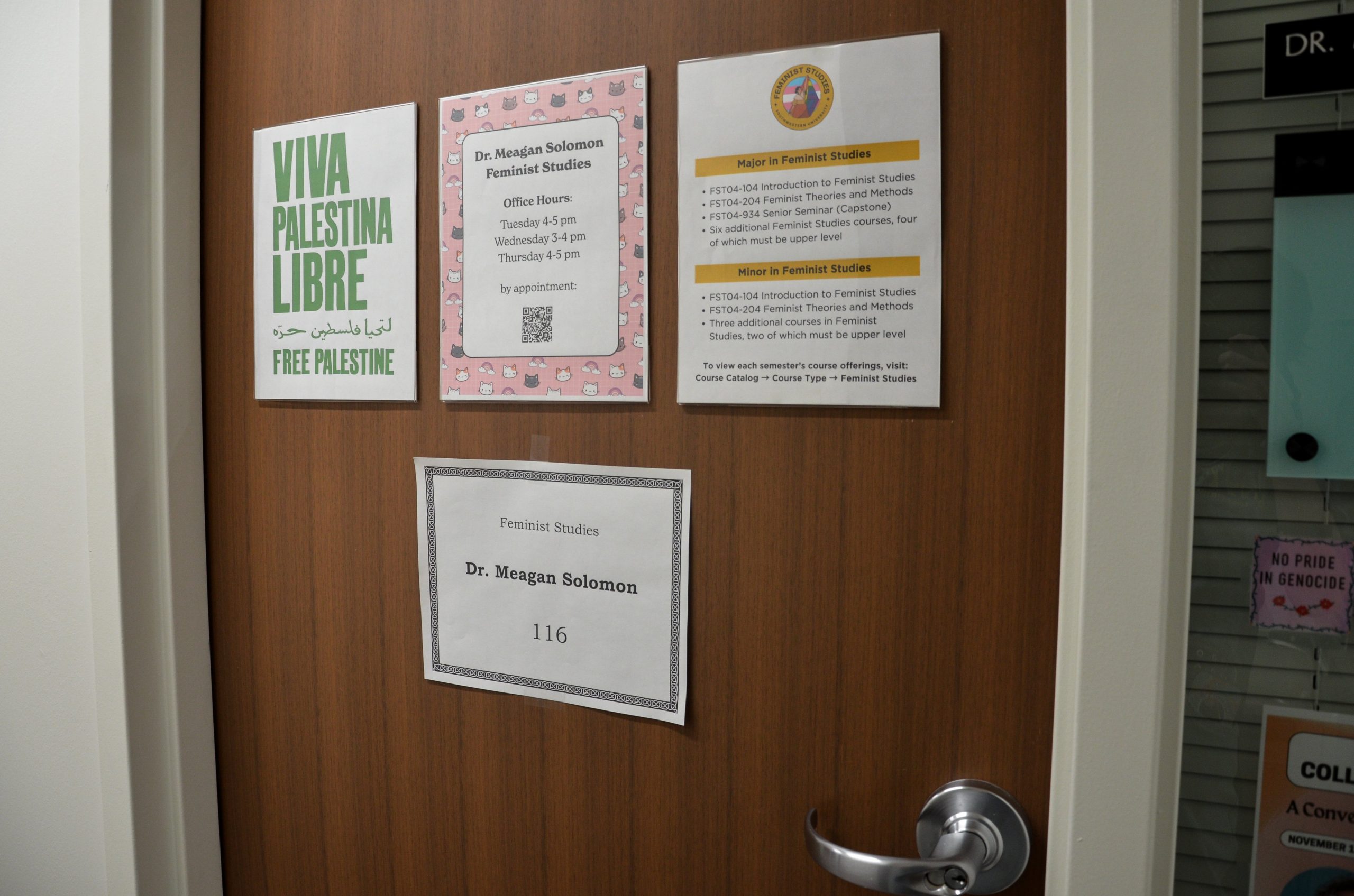
Dr. Meagan Solomon (she/her) is Southwestern University’s current leading professor of Feminist Studies. Her primary focus is in Latina lesbian literature, as well as Chicana feminist literature and intersectional queer studies. I met with Dr. Solomon in her office, a comforting space off of the sterile hallways of Mood. Considering I am currently in my third class with her, so I wasn’t expecting much new information; however, I was able to get a more in depth look into her life outside of Southwestern. Dr. Solomon is actually the person who taught me how to conduct interviews, so it felt like a very full circle moment to have the opportunity to put those skills into practice during our conversation. Thinking I’d never have those skills put to the test was quite naive of me, but I’m very grateful it was something that I learned my first year at university.
I started off with perhaps the most loaded question I could get: why feminist studies? Talking to her, it almost seemed like she was destined for this field ever since she was young. Dr. Solomon was raised purely by women. Whether this be her mom, grandmother, or tías, she was always surrounded by a female and feminine presence. The life she experienced growing up shaped her understanding of just how important women are, especially in families. These lived experiences also showed her the treatment that women receive and the lack of respect they are given.
Going beyond her relationships with the women who raised her, Dr. Solomon found feminism in other ways. Perhaps the most relatable to many, was the feminist community in online spaces, specifically Tumblr. Most queer people find their first community online, especially because things are anonymous, and they can use these spaces to educate themselves. This is where she was introduced to a larger vocabulary of terms relating to feminism, as well as terms related to queer identity. It’s also where she started to discover queer media.
Education also played a big part in Dr. Solomon’s coming into her feminist identity. In high school, she took a women’s literature class, which jumpstarted her entry into learning about feminism in a more formal context. After high school, Dr. Solomon continued her education at Tarrant County College, which she credits with the “sprouting of my political consciousness” in an organization called The Historical Underground. This is where three professors created a space for histories that weren’t mainstream, highlighting Queer, Black, and Brown histories. From there, Dr. Solomon transferred to the University of Texas at Arlington to complete her BA in English with a minor in Women’s and Gender Studies, where she became an active member of the department. On the graduate level, Dr. Solomon received her PhD in English with graduate certificates in Comparative Race and Ethnic Studies and Women and Gender Studies from TCU.
To truly make this a “researcher feature”, I asked Dr. Solomon about her current work and research outside of Southwestern, and if there was anything she wanted to highlight. She first highlighted Malflora Collective, a “community project dedicated to preserving the lives and legacies of Latina/e lesbians.” “Malflora” is a Spanish term that originated as a slur that roughly translates to “bad flower”, but has now been reclaimed in a similar way that “queer” has been. Malflora Collective is made up of nine members (including Dr. Solomon’s Research Assistant, Mia Santoscoy ‘26) of different backgrounds with a common focus on preserving these histories, as well as individual experiences. This collective focuses on archiving stories through creative means, which in this case is a magazine, as well as a podcast. The podcast serves as an oral history project where the three cohosts converse with guests to understand their backgrounds and how their upbringings has shaped their work. Malflora Collective serves as a much needed form of Latina/e lesbian preservation. They are working on creating a more organized archival hub on the website, so be sure to follow @malfloracollective on Instagram for updates.
Beyond Malflora Collective, Dr. Solomon is also working on other projects. She is starting to work on an edited collection focused on Latina/e lesbian legacies and futures, in which she will invite people to contribute to the collection. Finally, Dr. Solomon is embarking on a book project that builds from her dissertation. This will be based on how Latina/e lesbian writers and performers relate intimately and create solidarity networks across borders. Personally, I am looking forward to seeing where these projects go, and I would love to follow up on this feature before my time at Southwestern has come to an end.
Now, the main reason I wanted to have this conversation with Dr. Solomon was to discuss the lacking representation of people who are both queer and successful. Many college students struggle to see these two factors coexist, which leads them to believe that they will have to shutter their identity for the sake of success in the workplace. In response, Dr. Solomon asked the hard hitting question of “what is success?”
In dominant society, success is inherently tied to capitalism and how much money one can make, so defining success on a personal level can create a better understanding of what one wants to achieve in order to deem oneself as successful. She states, “any form of queer people living authentically was success for me.” Especially looking at the trope of “the lesbian dies”, it is important to see queer people living authentically in the media. As a college student, Dr. Solomon also had professors who were out as queer. These professors led her to see the discussions that could be had on the university level, which inspired her to be a professor herself. She also had various queer and lesbian mentors. Dr. Solomon credits her upbringing for shaping her into an activist, which is one of the ways she personally measures her success. She offers the advice: “once you can identify what success means to you, you can then decide how success fits into your identity.”
When asked how she combatted feeling lost in university, Dr. Solomon affirms that this is not a unique experience: “It is intensified when you are in a marginalized positionality and have to confront the external forces that go along with that.” She also shares that she was surrounded by queer people in college, and her queerness was more visible with the people she was with. However, Dr. Solomon found her biggest instance of imposter syndrome was based on her experience as a first-generation college student. She was the first person in her extended family to go to college, so there was an added layer of having to navigate things alone. Once again, she emphasizes community, and shared how the community she found in college fostered the feeling of feeling more safe in success.
As far as advice goes, Dr. Solomon recognizes her privilege of growing up in a supportive environment. “It’s important to be out in ways that feel safe, not everyone has to be out and proud all of the time.” She also encourages the cultivation of safe spaces where you can be out. These spaces can be in literature, film, music, online, as well as physical connections. There is a personal decision of when and where to disclose identity, and there is no universal experience on how to be, but creating these spaces leads to a better sense of community.
Dr. Solomon shares the importance of having intergenerational connections among queer people. She calls the connections she found with queer and lesbian Chicane scholars to be “lifechanging, because I felt so less alone to know that they have already gone through this.” She calls intergenerational connection a “reciprocal exchange” as all generations can benefit from learning from each other. Dr. Solomon recommends looking into local organizations such as ALLGO, which is an Austin based organization for queer people of color.
On a more personal note, Dr. Solomon is one of the best professors that Southwestern has to offer. She emphasizes her open-door policy, and encourages students to reach out for any questions or support they may need. As the conversation came to a close, Dr. Solomon stated, “we (queer people) exist in everyday life” which in my opinion, is one of the most important takeaways from this feature. When desperately looking for an open class that fit my schedule during SPROG, I never would have pictured that a bit over a year later, I’d be a Feminist Studies major. From the moment I walked into her classroom as a wide-eyed freshman, I knew I was going to have a safe space, one where I could be myself. Dr. Solomon taught me everything I know about what feminism truly is and has ignited a passion within me to truly enjoy a class. I am forever grateful to her, and I cherish the opportunity to conduct this interview. She is one of those special professors that students will plan their schedules just so they are able to take a class with her (cough cough me). Much like I tell all of my friends, I urge you to take a class with her, it will truly open your mind in the best way. Thank you, Dr. Solomon, for being so willing to participate, and remember to always #besouthwestern.